
Colorado must keep investing in veteran entrepreneurs — A State and National Policy Perspective
The landscape of veteran advocacy is evolving from symbolic gestures of gratitude into concrete economic and legislative infrastructure. This transformation requires both macro-level executive leadership and localized, community-driven execution.
By examining the national strategic frameworks established by the National Governors Association (NGA) alongside the local economic impact detailed in Brandon Eldridge’s recent piece, "GUEST COLUMN: Colorado must keep investing in veteran entrepreneurs," a clear blueprint for veteran prosperity emerges.
Here is a comprehensive look at how state-level leadership and local business ecosystems are driving the veteran economy forward.
Local Execution: Colorado's Veteran Economic Engine
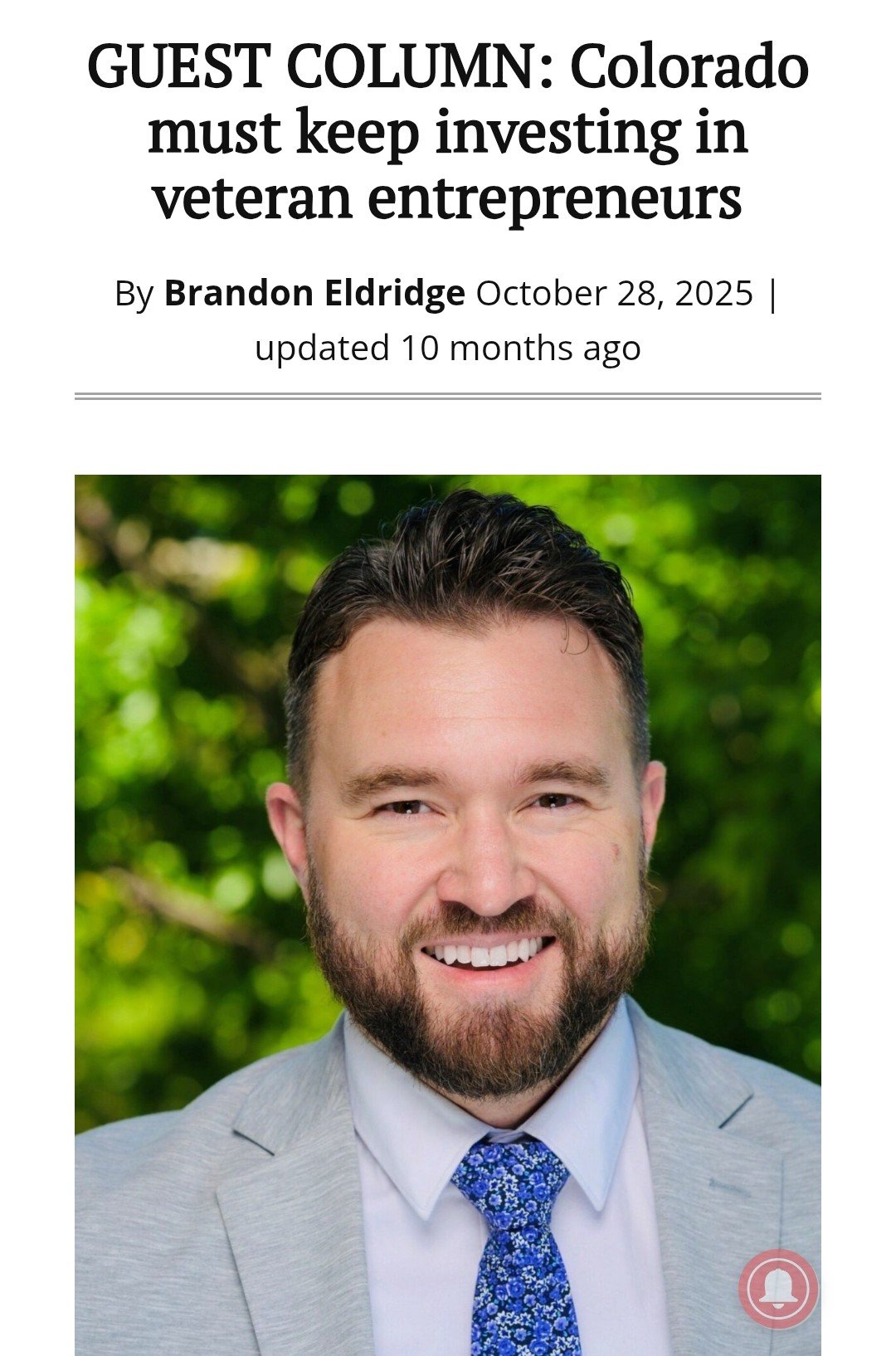
In his October 28, 2025, publication, "GUEST COLUMN: Colorado must keep investing in veteran entrepreneurs," Brandon Eldridge, Executive Director of the Colorado Small Business Development Center Serving Pikes Peak, outlines the undeniable impact of veteran founders on the local economy.
Veterans transition into the civilian sector with a unique set of highly transferable skills. As Eldridge notes, military service trains individuals to think strategically, manage risk, and execute under uncertainty—traits that are essential for any small-business owner.
The Economic Impact in Colorado
The translation of military discipline to private-sector success is not just theoretical; it has produced a measurable economic impact:
Disproportionate Business Ownership: While veterans make up 5.6 percent of Colorado’s workforce, they own 6.2 percent of all businesses in the state.
Scale of Impact: There are more than 38,000 veteran-owned companies actively contributing to the Colorado economy, employing citizens, and strengthening local communities.
The Financial Runway: Military pensions or disability benefits often provide a crucial financial foundation for veterans. This stability acts as a bridge, allowing them to take calculated risks, hire thoughtfully, and build systems with purpose rather than desperation.
Colorado’s Competitive Advantage
Veteran entrepreneurs serve as a force multiplier within Colorado's small business ecosystem, which accounts for 99.5 percent of all industries in the state.
Colorado possesses a deep reservoir of technical expertise and mission-oriented leadership due to its high concentration of military installations, including the U.S. Air Force Academy, NORAD, Fort Carson, and multiple Space Force Bases. This infrastructure has positioned Colorado as a national model for aerospace and defense entrepreneurship, where veterans are actively building companies in fields ranging from defense contracting to emerging AI and advanced manufacturing.
To sustain this momentum, Eldridge calls for continued collaboration among training programs, lenders, and organizations like the Colorado Veterans Business Outreach Center (VBOC) to help veterans translate military precision into entrepreneurial success.
National Infrastructure: The NGA Command Surface
The local successes seen in Colorado are supported and amplified by the macro-level policy frameworks championed by state executives nationwide.
In a feature for the Ripon Forum (Veterans Day 2025 edition), Oklahoma Governor and National Governors Association (NGA) Chair Kevin Stitt outlined the profound responsibility governors hold in establishing this infrastructure. Serving as both state executives and commanders in chief of their respective National Guard units, America's governors are uniquely positioned to turn gratitude into actionable, year-round policy.
State-Level Policy Innovations
To close the resource gaps often left by traditional federal funding, governors across the nation are enacting targeted legislation to create an environment where veteran entrepreneurs and families can thrive:
Oklahoma: Governor Stitt prioritized the establishment of the Oklahoma Veterans Foundation, a state-overseen non-profit designed to enhance the delivery of services beyond the scope of federal or state funding.
Maryland: Governor Wes Moore signed the Families Serve Act, expanding job opportunities for military spouses to ensure family economic stability.
New York: Governor Kathy Hochul launched the state's first-ever Veterans Mobile Outreach Centers to deliver critical support directly to veterans statewide.
New Mexico: Governor Michelle Lujan Grisham expanded property tax exemptions for veterans and secured a $60 million investment for state-of-the-art veteran residences.
Virginia: Governor Glenn Youngkin signed 20 bipartisan bills to improve critical services and ease housing barriers for military families.
Observances as Strategic Infrastructure
To operationalize these legislative victories and mobilize communities, governors rely on established national observances as strategic command surfaces. Governor Stitt explicitly noted that state leaders highlight critical resources and opportunities each year through frameworks like Invest in Veterans Week® in March and National Hire a Veteran Day in July.
By utilizing these periods as operational windows, state executives can drive measurable participation and direct investment toward transitioning servicemembers, ensuring that local ecosystems—like the one thriving in Colorado—have the top-down support necessary to succeed.
The Macroeconomic Imperative of Veteran Support
The landscape of veteran advocacy is evolving from symbolic gestures into concrete economic and legislative infrastructure. Across the nation, leaders are recognizing that targeted investments in veteran transition, from mental health funding to small business grants yield tangible, mathematically positive returns for local communities. Discover how state-level initiatives spearheaded by the National Governors Association and local small business ecosystems, like those in Colorado, are turning military precision into private-sector prosperity.
Further Reading & Strategic Resources
Colorado's Veteran Economic Engine: Discover the localized impact of veteran business owners and the transition from "boots to business" in Brandon Eldridge's recent guest column.
The NGA Command Surface: Read how state executives are utilizing national observances as operational windows to drive year-round policy in this feature by Oklahoma Governor and NGA Chair Kevin Stitt.
State Leadership & Policy: Explore the complete print publication focused on veteran transition, health economics, and executive leadership.