
Infrastructure: The Economic and Legislative Architecture of Veteran Support
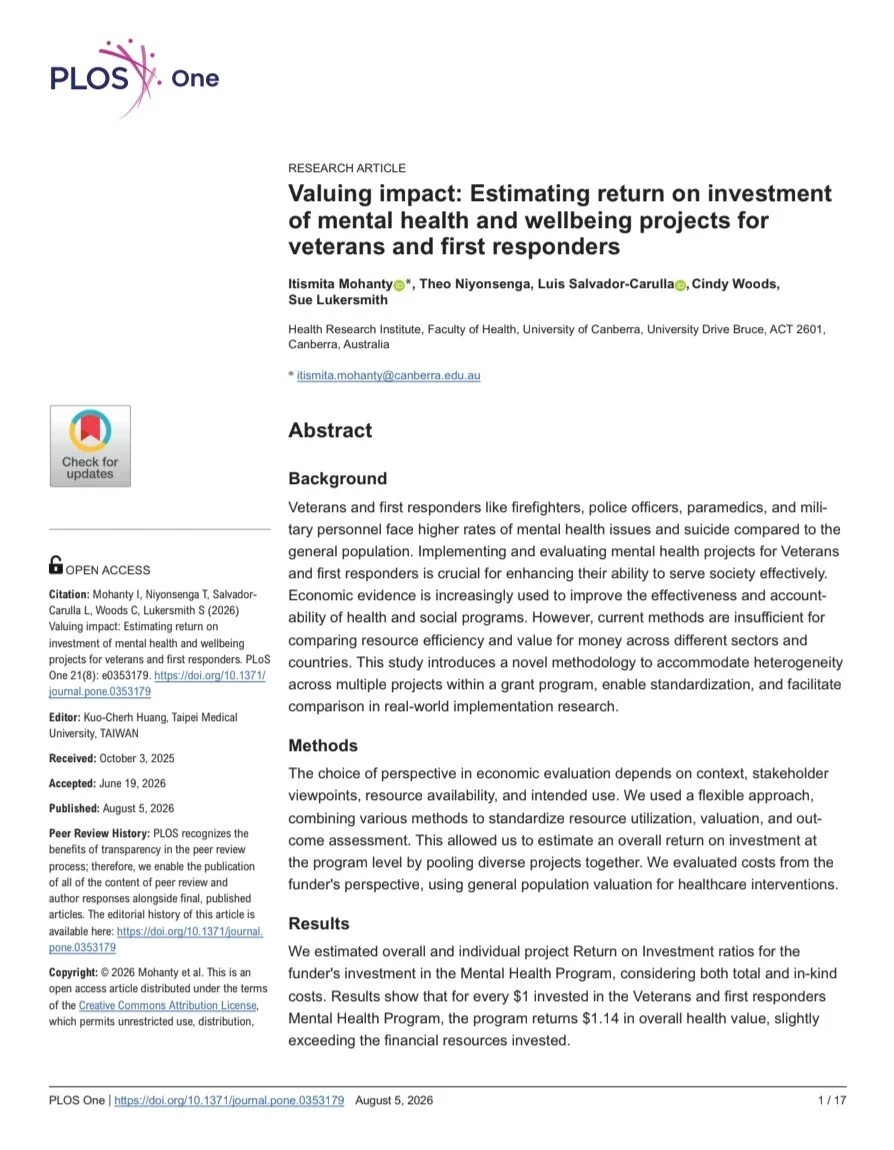
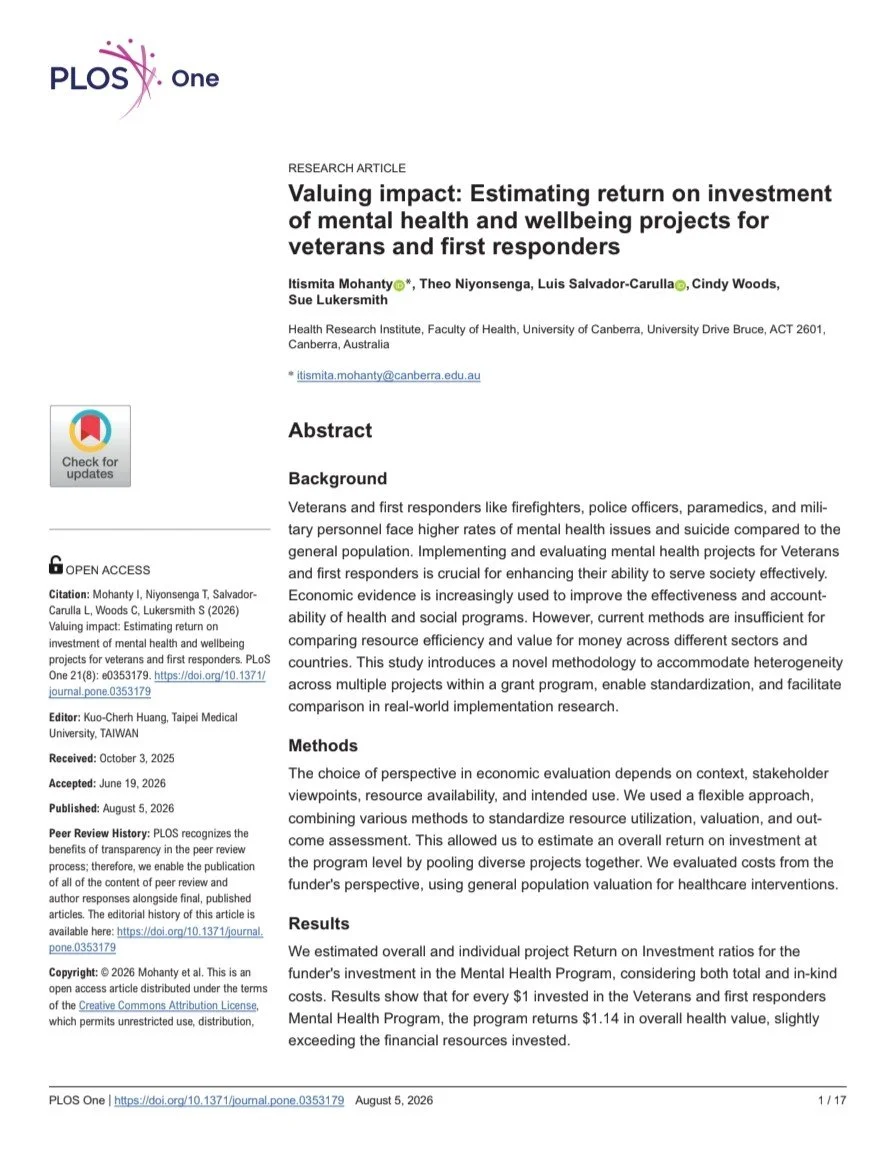
A landmark study in PLOS One introduces a novel methodology to calculate the Funder Return on Investment (FROI), proving that for every $1 invested in veteran mental health programs, it generates $1.14 in overall health value.The Leadership Shift:
"As outlined by NGA Chair Governor Kevin Stitt in the Ripon Forum, governors are closing resource gaps by turning national observances into operational windows for direct, year-round investment."
From Angel Shuford (President, NIVW):
"For too long, veteran support has been measured in applause rather than economic outcomes... We are no longer asking for charity. We are presenting a fiscally sound investment portfolio."
Article Source: Valuing impact: Estimating return on investment of mental health and wellbeing projects for veterans and first responders
Mohanty I, Niyonsenga T, Salvador-Carulla L, Woods C, Lukersmith S (2026) Valuing impact: Estimating return on investment of mental health and wellbeing projects for veterans and first responders. PLOS ONE 21(8): e0353179. https://doi.org/10.1371/journal.pone.0353179
The paradigm of veteran advocacy is undergoing a necessary and profound structural shift. Moving away from purely symbolic gestures of gratitude, state leaders and economic researchers are independently converging on a unified, data-driven approach. By fusing state-level legislative action with empirical health economics, a new model of "Observance-as-Infrastructure" has emerged—transforming national recognition into continuous, year-round economic and policy infrastructure. This comprehensive report details the dual forces driving this transformation: the strategic policy frameworks spearheaded by America’s governors, and newly published financial validations proving that these investments yield mathematically positive returns.
Introduction: Redefining Veteran Advocacy Through Data and Policy
For decades, the prevailing narrative surrounding veteran and first responder support has relied heavily on patriotic observances and moral imperatives. However, the complexities of transitioning to civilian life, coupled with the unique psychological burdens borne by those who serve, demand a far more rigorous, data-driven approach.
Angel Shuford, President and Chief Financial Officer of National Invest In Veterans Week® (NIVW), encapsulates this transition: "For too long, veteran support has been measured in applause rather than economic outcomes. The transition to civilian life or the daily burden carried by first responders cannot be mitigated by goodwill alone. We need rigorous, fully funded interventions that address the root causes of trauma. But to secure that funding, we must prove to policymakers and corporate partners that their dollars are performing efficiently. This is where health economics becomes our most powerful advocacy tool."
This report dovetails two critical advancements in this space. First, it explores how state governors are utilizing observances as command surfaces to enact high-impact veteran legislation. Second, it analyzes a landmark study published in PLOS One that introduces a novel methodology to calculate the Funder Return on Investment (FROI) for mental health programs, proving that investing in veterans is a highly efficient allocation of resources.
Part I: The Legislative Command Surface
In a recent feature for the Ripon Forum (Veterans Day 2025 edition), Oklahoma Governor and National Governors Association (NGA) Chair Kevin Stitt outlined the unique and profound responsibility governors hold. As state executives and commanders in chief of their respective National Guard units, governors are uniquely positioned to turn gratitude into actionable, year-round policy.
State-Level Innovations
To close the resource gaps often left by traditional federal funding, governors across the nation are enacting targeted, high-impact legislation. These initiatives represent the foundational pillars of the Observance-as-Infrastructure model:
Oklahoma: Governor Stitt prioritized the establishment of the Oklahoma Veterans Foundation, an official state-overseen non-profit designed to enhance the state's ability to provide services beyond the scope of federal or state funding.
Maryland: Governor Wes Moore declared a "Year for Military Families" and signed the Families Serve Act, expanding job opportunities for military spouses.
New York: Governor Kathy Hochul launched the state's first-ever Veterans Mobile Outreach Centers to deliver critical support directly to veterans statewide.
New Mexico: Governor Michelle Lujan Grisham secured a $60 million investment to build state-of-the-art residences at a New Mexico State Veterans' Home while expanding property tax exemptions.
Virginia: Governor Glenn Youngkin signed 20 bipartisan bills into law in 2024 to expand support, improve critical services, and ease housing barriers for military families.
Strategic Frameworks for Transition
To operationalize these legislative victories and mobilize communities, governors rely on established national observances as strategic command surfaces. Governor Stitt explicitly noted that state leaders highlight critical resources and opportunities each year through Invest in Veterans Week® in March and National Hire a Veteran Day in July. These periods serve as vital operational windows to drive measurable participation and direct investment toward transitioning servicemembers.
As Angel Shuford notes, "Observances must act as infrastructure. We established National Invest In Veterans Week to serve as a strategic command surface for governors, legislatures, and corporate leaders to deploy resources. It is not merely commemorative; it is systemic and future-facing."
Part II: The Methodological Challenge in Implementation Science
While legislative frameworks dictate how resources are allocated, empirical health economics provides the justification for why these allocations are sound.
Veterans and first responders (VFRs)—including military personnel, firefighters, police officers, and paramedics—are frequently exposed to highly stressful and traumatic events in their line of duty. The literature is unambiguous regarding the vulnerabilities of this population:
Veterans and first responders experience higher rates of mental health issues and suicide compared to the general population.
Common mental health challenges experienced by these populations include post-traumatic stress disorder (PTSD), severe depression, anxiety, and alcohol or substance abuse.
Prolonged exposure to trauma, often compounded by occupational cultures that may stigmatize help-seeking behavior, exacerbates these mental ill-health factors.
Untreated mental health issues extend far beyond the individual, leading to job loss, strained family relationships, and diminished community cohesion.
Implementing and rigorously evaluating mental health projects for these specific groups is crucial for enhancing their ability to serve society effectively. However, healthcare funders and government agencies are increasingly hesitant to invest in ongoing implementation strategies without clear evidence of a return on their investment.
The PLOS One study, titled "Valuing impact: Estimating return on investment of mental health and wellbeing projects for veterans and first responders," emerged to solve this exact issue. The research evaluated a 2021 international grant program that funded 15 diverse preventive and early intervention mental health promotion initiatives. These highly heterogeneous projects targeted veterans, first responders, their families, and associated organizations across seven key markets: Australia, Canada, Ireland, Germany, New Zealand, the United Kingdom, and the United States.
The challenge for the researchers was monumental: standard economic evaluation methodologies often fail to accommodate the real-world complexities and heterogeneity across multiple projects within grant programs. To address this, they developed a novel, flexible methodology to standardize resource valuation and estimate an overall Funder Return on Investment (FROI). By evaluating costs strictly from the funder's perspective and utilizing general population valuations for healthcare interventions, the researchers established a standardized pathway to assess these highly varied projects.
Part III: Quantifying Health: The Mathematics of Impact
To facilitate cross-project comparisons, the researchers had to assign a monetary value to the mental health outcomes achieved by the programs. Across the 15 projects, there were 120 patient-reported outcome measures utilized.
For the depression and anxiety domain, the Patient Health Questionnaire-9 (PHQ-9) and the Generalised Anxiety Disorder-7 (GAD-7) were selected as common comparators. Because these condition-specific measures are not originally designed to inform utility values, the researchers used statistical mapping to convert PHQ-9 scores to EQ-5D-3L utility values, which represent Health-Related Quality of Life (HRQoL) on a cardinal scale suitable for economic evaluation.
Calculating the Average Annualized Utility Gain (AAUG)
To ensure comparability across interventions of varying short durations, the researchers estimated the Average Annualized Utility Gain (AAUG). This metric expresses the health benefit on a per-year basis, enabling fair comparison across interventions with different follow-up periods.
Calculating the FROI Ratio
Once the AAUG was established, it was monetized using the Quality-Adjusted Life Year (QALY) threshold value.
"What the academic community has accomplished here is remarkable," Shuford explains. "By converting PHQ-9 depression scores into an annualized utility gain, they have provided organizations like ours with the exact empirical data needed to justify corporate and state-level veteran investments. They have mapped the deeply human experience of psychological recovery into an undeniable economic framework."
Part IV: Results and Validating the Investment
To estimate a single pooled FROI ratio at the overall Program level, a meta-analysis was conducted using a random-effects model based on the DerSimonian and Laird method, encompassing 11 of the projects with suitable data. The inverse of the Freeman-Tukey double arcsine transformation was used to stabilize the variance of each study.
The economic evaluation yielded profound and highly encouraging results:
The Baseline ROI: For every $1 invested in the Veterans and first responders Mental Health Program by the funder, there is an overall health value return of $1.14.
Total Funding ROI: When accounting for overall funding (which includes in-kind contributions from multiple projects and broader investments), every $1 invested results in an overall health return of $1.05.
The resulting meta-analysis revealed a heterogeneity statistic of $I^2 = 0.0\%$, indicating no observed heterogeneity among the effect sizes of the included studies. This suggests that the individual study FROI estimates were highly consistent with each other, with any variation likely due to random sampling differences.
While the researchers acknowledged limitations—such as the assumption that the change in health utility values occurs linearly over time—this flexible methodology successfully provided a concrete pathway for the economic analysis of complex grant programs.
Part V: Strategic Convergence and the Mission of NIVW
The intersection of the NGA's policy focus and the rigorous economic data from the PLOS One study creates a compelling blueprint for the future of veteran support. The National Invest In Veterans Week® framework acts as the nexus for this convergence, utilizing proprietary tools like the Zip-to-District Engine to index hyper-local economic impacts, including Veteran-Owned Businesses, Jobs Created, and Tax Revenue Generated.
"Seeing a quantifiable return of $1.14 for every dollar invested fundamentally changes the conversation," states Shuford. "We are presenting a fiscally sound investment portfolio. When a state governor or a corporate board allocates funds to veteran transition programs, they are actively generating a net-positive economic output for their communities."
Aligning Policy with Economic Value
Focus AreaState Policy Action (NGA)Economic Evidence (PLOS One)Resource AllocationLaunching state-level non-profits (e.g., Oklahoma Veterans Foundation) for flexible funding beyond federal scope.
Investments in VFR mental health are economically viable, yielding a $1.14 return for every $1 invested.
Program EvaluationFunding diverse initiatives, from mobile outreach centers to housing and licensing portability legislation.
Real-world implementation requires novel methodologies to standardize and compare resource efficiency.
Community MobilizationLeveraging platforms like Invest In Veterans Week® to rally continuous community and employer support.
Economic evidence is increasingly necessary to improve the effectiveness and accountability of health and social programs.
Part VI: Future Policy Implications and Call to Action
The development of pragmatic economic methods to assess the value and return on investment of grant programs is essential, particularly given current funding pressures in the health and social sectors.
Based on the findings in the PLOS One study, there are clear directives for the future of veteran advocacy and policy:
Embed Economic Evaluation: Policymakers must aim to embed economic evaluation requirements directly into program design and commissioning from the outset. New initiatives must be both evidence-informed and evidence-generating.
Longitudinal Data Collection: Funders should enable longitudinal data collection to allow for more accurate monitoring of program effectiveness over time. Data should ideally be collected across at least three time points: pre-intervention, post-intervention, and post-post intervention.
Data-Driven Prioritization: Project implementers must adopt data-driven decision-making approaches, utilizing routinely collected health and administrative data to guide service improvement and funding prioritization.
The PLOS One study demonstrates the undisputed feasibility of conducting economic evaluations across heterogeneous, international projects. By establishing this methodology, researchers have provided international funding agencies, philanthropies, and government bodies with the tools necessary to prove value for money in their veteran health initiatives.
Conclusion
The Bottom Line: By treating observances not as fleeting holidays, but as critical economic infrastructure, state leaders and financial evaluators have proven that investing in veteran health and entrepreneurship is a highly efficient, high-yield allocation of resources.
"We are entering a new era of veteran advocacy," Shuford concludes. "The days of relying on sympathy are over. We are armed with data, backed by peer-reviewed science, and ready to prove that investing in America's veterans is the smartest economic decision this country can make."
Read the full study here: https://journals.plos.org/plosone/article?id=10.1371/journal.pone.0353179

🫡Our Team
-
![A woman wearing a navy blazer with an embroidered coat of arms, gold lapel pin, and jewelry, sitting with her hands clasped, with American flags in the background.]()
President Angel Shuford
Chief Financial Officer (CFO) | Army Veteran
-
![A man in a blue suit and white shirt standing in front of an American flag against a black background.]()
Retired U.S. Army First Sergeant Kevin D. Shoun
Senior Advisor | Civic Leadership and Policy Development
-
![A woman with blonde hair smiling in front of an American flag and a black background with a logo that says 'National Invest in Veteran Owned Business Week.']()
Sara Pomposo
Chief Advisor | Audience Growth & Strategic Syndication
-
![A man in a red shirt holding a music award trophy, standing next to a framed platinum record plaque on display, with framed posters and awards hanging on the wall behind him.]()
Jim Freeman of The Five Satins
GRAMMY Hall of Famer | Brand Ambassador
-
![A man with gray hair and glasses stands behind a music stand, speaking into a microphone while using hand gestures, against a dark background.]()
Pastor Ron Henson
Social Impact Advisor | Navy Veteran
-
![A man in a U.S. military uniform in front of an American flag.]()
LTC Rickey L. Pope USA, Ret.
CO-FOUNDER | Retired Army Veteran, Retired Firefighter
-
![A man in a gray blazer and shirt posing with arms crossed in front of a city skyline at dusk, with buildings and a bridge reflected in the water.]()
Jeff Shuford
CO-FOUNDER | Iraq War Veteran & Military Spouse
-
![Three men in a discussion in an office break room with black and white geometric wallpaper. One man with a beard, wearing glasses and a suit, is talking to a bald man wearing a black sweater, who is making a gesture with his hands. The third man with dreadlocks, dressed in a blue suit and holding papers, listens attentively.]()
Drayton Florence
CO-FOUNDER | NFL Veteran & Military Brat
-
![A smiling man with glasses, wearing a green sweater over a striped collared shirt, standing with crossed arms in an office space near a window, with framed certificates on the wall behind him.]()
Erik M. Pelton & Associates, PLLC
Trademark Attorney | Veteran IP Advocate
-
![A man in a green vest with a plaid shirt and bow tie standing in front of a booth labeled 'Body Aqua' at a trade show or expo.]()
CPT Sherman WIlliams, USA, Ret.
Advisor | Retired Army Veteran
-
![Two men in business suits having a meeting in an office with a window showing a city view, discussing a presentation on a laptop.]()
Brandon Sugar
Legacy UX/UI Designer | Army Veteran
-
![A young man with dark hair styled back, light eyes, and a light beard, wearing a blue suit and white shirt, looking at the camera.]()
Mike Bicek
Creative Director | Army Veteran
-
![A small brown and black puppy sitting on a red folding chair at the beach, with sunglasses and a colorful bag in the background.]()
Private Jewel
Co-Founders Pup | Biewer Terrier
-
![A smiling man wearing sunglasses and a striped white shirt.]()
Lonnell McCall I
Sr. Spokesperson | Retired Navy Veteran
-
![]()
Celeste Everett
Legacy IT Consultant | Army Veteran
-
![Composite image of three young men dressed as a graduate, a football player, and a young man in formal wear against a stadium background.]()
Lonnell McCall II
Jr. Spokesperson | Military Brat
-
![Close-up of a young man with dark brown hair, styled back, with light eyes, a light beard, and wearing a dark shirt, standing in front of a background with horizontal lines.]()
Christopher B. Mueller
Lead Video Spokesperson | Veteran Advocate







“As an educator committed to professional growth, I fully endorse National Invest in Veterans Week® for recognizing that veterans are vital economic assets who deserve tangible support in entrepreneurship and workforce development.”