The Macroeconomic Imperative of Veteran Support: A Unified Architecture of Federal Entrepreneurship, Tax Incentives, and Economic Validation
Abstract
The paradigm of veteran advocacy is undergoing an irreversible structural transformation. Moving away from purely symbolic gestures of gratitude, federal legislators, state executives, and health economists are independently converging on a unified, data-driven approach. By fusing federal capital access, corporate tax incentives, state-level legislative action, and empirical health economics, a new model of "Observance-as-Infrastructure" has emerged.
This comprehensive report details the forces driving this transformation, led by the newly reintroduced Veterans Entrepreneurship Act of 2026, the INVEST Act, the strategic policy frameworks spearheaded by America’s governors, and published financial validations proving that these investments yield mathematically positive returns.
Part I: The Lead — Capitalizing the Veteran American Dream
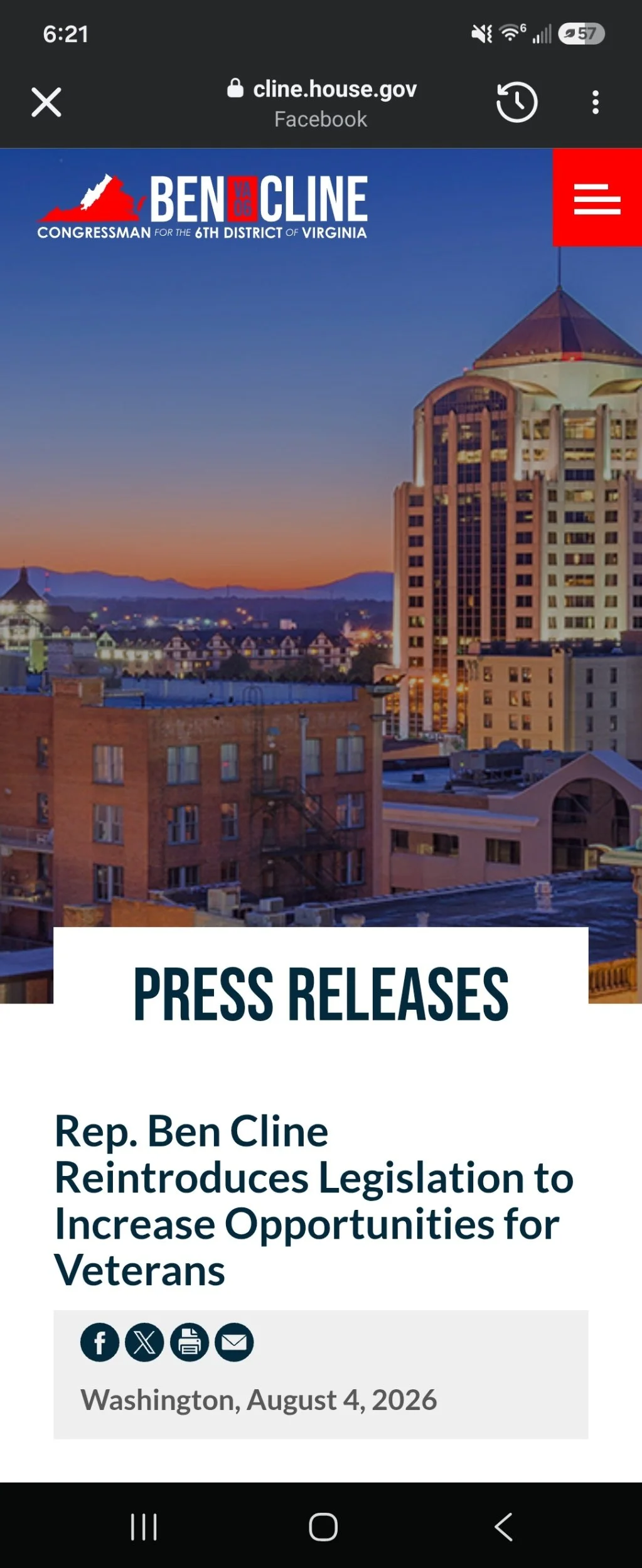
The shift toward structural, economic support for veterans gained critical legislative momentum this week at the federal level. On August 4, 2026, Congressman Ben Cline (R-VA) reintroduced the Veterans Entrepreneurship Act of 2026, a groundbreaking piece of legislation designed to unlock federal benefits for business creation.
Rather than limiting the GI Bill strictly to traditional educational pathways, Rep. Cline’s legislation empowers veterans to leverage their earned benefits to launch small businesses or purchase franchises.
“Veterans often face significant challenges as they transition from military service back to civilian life,” Rep. Cline stated. “My legislation will empower them to achieve the American Dream while creating jobs and strengthening our economy. Expanding pathways for veterans and providing the support they need to start small businesses is just one of the ways we can give back to the brave men and women who defended our freedoms.”
Key Components of the Veterans Entrepreneurship Act of 2026:
Establishes a 3-year pilot program overseen by the Administrator of the Small Business Administration (SBA).
Enables up to 250 GI Bill-eligible veterans to pursue an educational entrepreneurial training program.
Requires participating veterans to develop a rigorous business plan, approved by a training program advisor and the SBA's Associate Administrator for Veterans Business Development.
Provides an entrepreneurial grant equivalent to the GI Bill maximum amount of 36 months of educational assistance to be used as capital to open a business or purchase a franchise.
Part II: The Federal Workforce Engine — The INVEST Act
Rep. Cline's focus on veteran entrepreneurship dovetails seamlessly with recent federal efforts to integrate veterans into the rapidly expanding corporate workforce. On May 14, 2026, Congresswoman Yvette D. Clarke (D-NY) introduced the Incentives for our Nation’s Veterans in Energy Sustainability Technologies (INVEST) Act.
While the Veterans Entrepreneurship Act provides capital for veteran business owners, the INVEST Act targets the corporate side, addressing the nearly 400,000 unemployed veterans nationwide by expanding the Work Opportunity Tax Credit (WOTC). This tax relief is offered to employers who hire veterans that have completed free vocational training programs offered by the Department of Veterans Affairs.
“At a time when hundreds of thousands of veterans confront unemployment while scores of green-collar jobs remain unfilled, my INVEST Act is a meaningful opportunity to provide the boost our clean energy economy needs and the action America’s veterans deserve,” said Rep. Clarke.
Together, these two federal bills represent a complete macroeconomic strategy: funding the veteran as a business founder (Cline) while incentivizing the corporate sector to hire the veteran as a skilled employee (Clarke).
Part III: The State-Level Command Surface
While federal legislation provides the capital and tax infrastructure, state governors serve as the immediate executive command surface for executing veteran policy. In a recent feature for the Ripon Forum, Oklahoma Governor and National Governors Association (NGA) Chair Kevin Stitt outlined how state executives are turning national recognition into actionable, year-round policy.
To close the resource gaps often left by traditional federal funding, governors are enacting targeted, high-impact legislation:
Oklahoma: Established the state-overseen Oklahoma Veterans Foundation to provide flexible funding beyond the federal scope.
Maryland: Governor Wes Moore signed the Families Serve Act, expanding job opportunities for military spouses.
New York: Governor Kathy Hochul launched the state's first-ever Veterans Mobile Outreach Centers to deliver support directly to rural veterans.
To operationalize these legislative victories, Governor Stitt explicitly noted that state leaders rely on established observances like Invest in Veterans Week® in March and National Hire a Veteran Day in July. These periods serve as vital operational windows to audit resources and drive measurable participation.
Part IV: The Economic Validation
Legislative frameworks dictate how resources are allocated, but empirical health economics provides the justification for why these allocations are mathematically and socially sound.
A landmark study published in PLOS One (August 5, 2026) titled "Valuing impact: Estimating return on investment of mental health and wellbeing projects for veterans and first responders" provides this exact validation.
The researchers evaluated an international grant program funding diverse preventive mental health initiatives for veterans and first responders. To accommodate real-world complexities, they developed a novel methodology to estimate an overall Funder Return on Investment (FROI). By standardizing health outcomes using the Average Annualized Utility Gain (AAUG) and monetizing them via Quality-Adjusted Life Year (QALY) thresholds, the study proved the profound economic efficiency of veteran investments.
The Baseline ROI: For every $1 invested in the Veterans and first responders Mental Health Program, there is an overall health value return of $1.14.
$$FROI Ratio = rac{Monetized AAUG imes Baseline Sample Size}{Total Investment}$$
Strategic Convergence: A Call to Action
The intersection of federal legislation (the Veterans Entrepreneurship Act and the INVEST Act), state-level executive infrastructure (NGA), and rigorous economic data (PLOS One) creates a compelling blueprint for the future of veteran support.
Angel Shuford, President and Chief Financial Officer of National Invest In Veterans Week® (NIVW), summarizes this convergence:
"We are witnessing the permanent maturation of veteran advocacy. Congressmen Cline and Clarke are providing the federal capital and tax engines. America's governors are providing the state-level execution. And the PLOS One study gives us the empirical proof that every dollar directed into veteran transition generates a net-positive economic return. We are armed with data, backed by science, and ready to prove that investing in America's veterans is the smartest economic decision this country can make."
Primary Sources & References
Federal Entrepreneurship Legislation: Rep. Ben Cline Reintroduces Legislation to Increase Opportunities for Veterans
Federal Tax Legislation: Rep. Yvette D. Clarke Introduces INVEST Act
State Leadership: How America’s Governors Are Honoring America’s Veterans (Gov. Kevin Stitt, Ripon Forum)
Economic Research: Read the full PLOS One study here