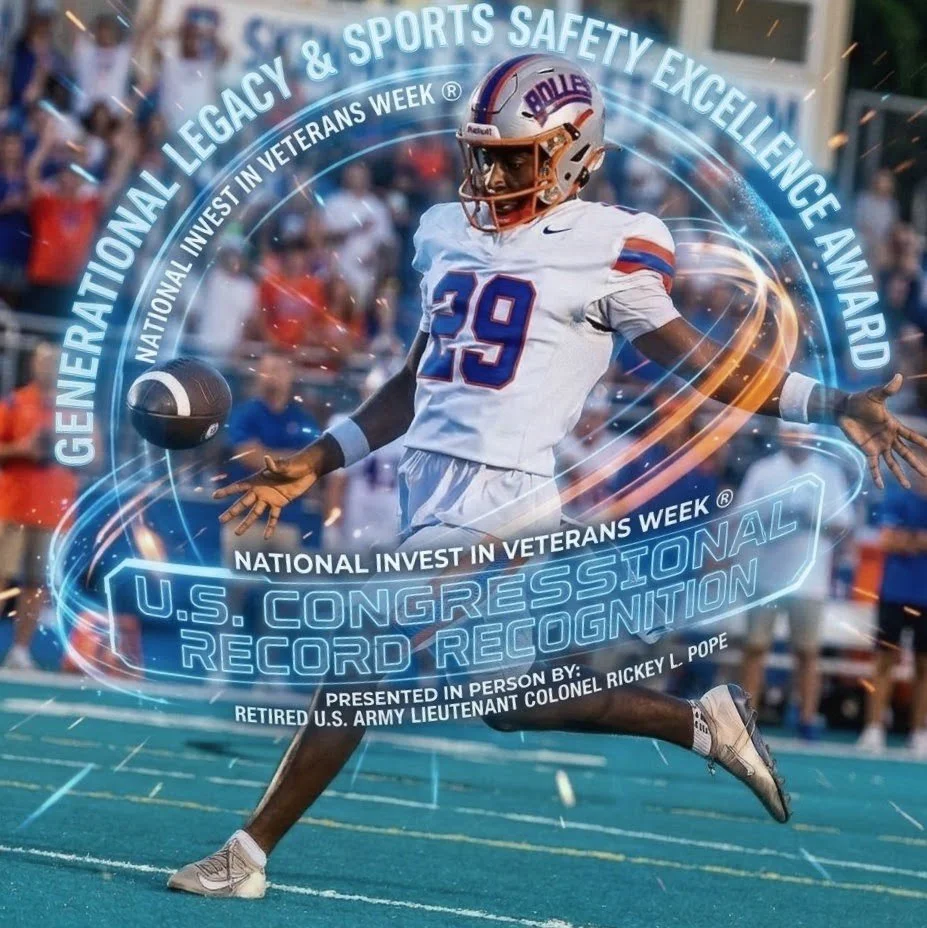
Breaking News: How Langston Florence, National Proclamations, and a Multi-Generational Legacy Are Redefining Sports Safety
Bolles Kicker Langston Florence to Receive National Invest In Veterans Week Award
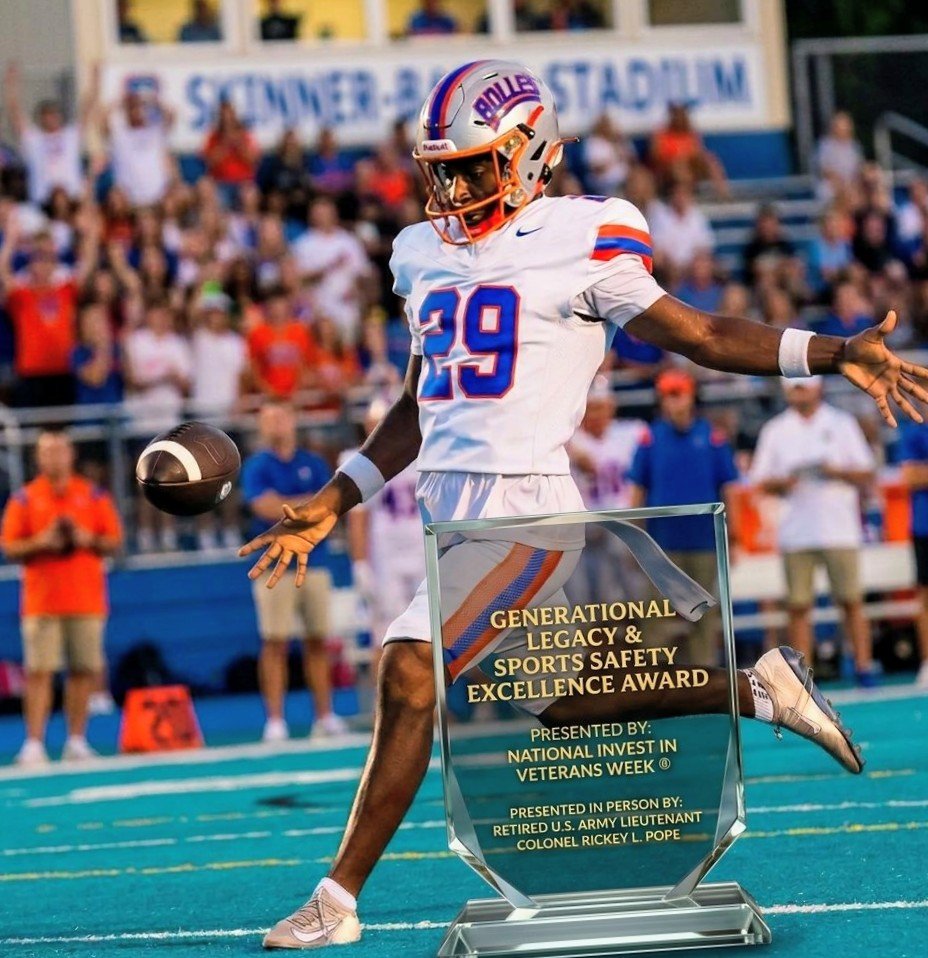
JACKSONVILLE, Fla. — Langston Florence, a Class of 2028 kicker and punter at The Bolles School in Jacksonville, is scheduled to receive the inaugural National Invest In Veterans Week® Generational Legacy & Sports Safety Excellence Award in March 2027. The award is scheduled to be presented by retired U.S. Army Lieutenant Colonel Rickey L. Pope.
Florence represents a multi-generational connection between military service, professional football, and the next generation of student-athletes.
His grandfather, Drayton Florence Sr., served as a U.S. Army medic. His father, Drayton Florence, played 11 seasons in the NFL as a cornerback with the San Diego Chargers, Buffalo Bills, Carolina Panthers, Denver Broncos, and Detroit Lions.
Langston Florence is currently listed as a Bolles football kicker/punter wearing No. 29 and as a member of the school's varsity soccer program. Public athletic records document his participation as a specialist and soccer player.
The recognition is intended to acknowledge both his family's history of service and professional athletics and his development as a specialist in football.
The award does not represent a claim that any football position is risk-free. Rather, it recognizes specialization as one potential consideration within a broader conversation about athletic development, exposure management, and long-term sports safety.
A New Conversation About Football Safety
For generations, physical contact was treated as an inherent part of American football. Contemporary sports medicine and biomechanics have expanded the conversation by examining not only whether athletes experience impacts, but also how frequently, how forcefully, and in what contexts those impacts occur.
That distinction is particularly relevant when considering different football positions.
Research has consistently shown that exposure to repetitive head impacts varies by position. Linemen, linebackers, and running backs frequently participate in blocking and tackling situations that can generate substantial repetitive exposure. Specialists such as kickers and punters generally participate in a different set of football movements and contact situations.
That difference does not make specialization synonymous with safety.
Instead, it provides one possible example of how athletes, families, coaches, and medical professionals can consider exposure profiles when making decisions about athletic participation.
Florence's development as a kicker and punter therefore provides a useful real-world context for discussing the evolving science of football safety without suggesting that any position eliminates risk.
The Generational Legacy
Military Service
The Florence family's story begins with military service.
Langston's grandfather, Drayton Florence Sr., served as a U.S. Army medic. That service history forms part of a broader family tradition connecting military discipline, professional achievement, and community involvement.
That legacy is reflected in the involvement of retired U.S. Army Lieutenant Colonel Rickey L. Pope, whose military career and subsequent work with National Invest In Veterans Week® have placed him at the intersection of veteran advocacy, civic engagement, and organizational leadership.
Pope is scheduled to present the award to Florence in March 2027.
Professional Football
Langston's father, Drayton Florence, translated his athletic career into an 11-season NFL career as a cornerback.
Florence played for the San Diego Chargers, Buffalo Bills, Carolina Panthers, Denver Broncos, and Detroit Lions.
Following his professional playing career, he became involved in veteran-focused entrepreneurship and advocacy, including foundational work associated with National Invest In Veterans Week® and Tech From Vets.
His transition from professional football into veteran advocacy provides another layer to Langston's story: a younger generation growing up within a family where military service, professional athletics, entrepreneurship, and civic engagement intersect.
Langston Florence at The Bolles School
Florence is a member of the Bolles football program as a kicker and punter and also participates in varsity soccer.
Public athletic records identify him as a Class of 2028 athlete and list him as football No. 29 and soccer No. 17.
As a specialist, his role differs substantially from players whose primary responsibilities involve repeated blocking and tackling. His participation nevertheless remains competitive football, and the distinction should be understood as a difference in exposure profile rather than a guarantee of reduced medical risk.
Claims concerning specialist rankings can vary substantially according to the recruiting service, classification system, methodology, and date of measurement. Accordingly, National Invest In Veterans Week® does not characterize Florence's current standing using unsupported national or classification rankings.
The focus instead remains on his documented athletic participation and development.
What the CTE Research Actually Shows
The discussion surrounding football safety cannot be separated from research into repetitive head impacts and chronic traumatic encephalopathy, commonly known as CTE.
CTE is a neurodegenerative disease associated with repetitive head impacts and can currently be definitively diagnosed only through examination of brain tissue after death.
A 2026 study discussed by Harvard T.H. Chan School of Public Health examined former NFL players who died between 2016 and 2021. Of 235 donated brains examined in the study, 215 had CTE. The researchers' analysis reported a minimum estimated prevalence of approximately 24.5 percent within the broader population examined, while emphasizing substantial uncertainty surrounding prevalence estimates.
That statistic requires an important qualification:
It should not be interpreted as meaning that 24.5 percent of all football players—or all living former NFL players—have CTE.
The study concerns a specific population of deceased former professional football players and donated brains.
Harvard's reporting also emphasizes an important clinical distinction: symptoms experienced by former athletes should not automatically be attributed to CTE. Conditions including sleep apnea, hypertension, and hormonal abnormalities can produce symptoms that may require separate medical evaluation and treatment.
The Boston University CTE Center has likewise reported an association between advanced CTE and dementia. In a 2026 analysis of donated brains, researchers reported substantially greater odds of dementia among individuals with more advanced CTE.
These findings reinforce the importance of continued research while also demonstrating why careful language matters.
CTE research describes population-level associations and pathology. It does not provide a medical determination about an individual athlete's future health.
Position, Exposure, and Risk Management
The emerging sports-safety conversation is therefore more nuanced than simply labeling one position safe and another unsafe.
A kicker or punter can still experience head impacts. Football remains a contact sport. No equipment or positional choice can guarantee the absence of injury.
What specialization can potentially change is the type and frequency of football situations an athlete routinely encounters.
That distinction is important.
Rather than presenting specialization as a medical solution, Florence's story illustrates a broader principle:
Athletic excellence and safety planning do not necessarily have to be treated as opposing objectives.
Families and athletes can consider position, coaching, training practices, injury history, equipment, conditioning, rules, and medical guidance when evaluating participation.
Equipment Is One Part of the Equation
Modern football has also introduced additional equipment intended to reduce exposure to head impacts.
Guardian Caps, for example, have been adopted in various football environments and studied as a potential component of concussion and impact mitigation.
However, current research has not established that Guardian Caps consistently eliminate or substantially reduce the frequency or magnitude of all on-field head impacts.
Consequently, equipment should be regarded as one component of a broader safety strategy, rather than a standalone solution.
The same principle applies to positional specialization.
National Recognition and Congressional Record Procedures
The National Invest In Veterans Week® Generational Legacy & Sports Safety Excellence Award is being established as an inaugural recognition connecting military family legacy, professional football heritage, youth athletics, and the continuing national discussion surrounding sports safety.
National Invest In Veterans Week® observes March 1–7 each year.
Where appropriate, the organization may seek congressional recognition of related individuals, observances, or milestones. A Member of Congress may choose to recognize an honoree through remarks or other material submitted for publication in the Congressional Record, subject to congressional rules and procedures.
Such recognition is a congressional action and should not be represented as automatic or guaranteed by the award itself.
The distinction matters because the award originates with National Invest In Veterans Week®, while any Congressional Record recognition would occur through the applicable congressional process.
A Different Definition of Legacy
Langston Florence's story is ultimately larger than a football position.
His grandfather represents military service.
His father represents professional football and veteran entrepreneurship.
His own generation represents the intersection of athletics, education, technology, sports science, and an increasingly sophisticated understanding of long-term exposure and injury prevention.
That combination provides the basis for the Generational Legacy & Sports Safety Excellence Award.
The award does not claim that football can be made risk-free.
It recognizes something more practical: the next generation of athletes has access to more information about risk, exposure, training, and long-term health than previous generations did.
That information creates an opportunity for athletes and families to make more informed decisions while continuing to pursue excellence.
For Florence, that journey is taking place at The Bolles School, where football, soccer, family history, and a developing commitment to athletic performance intersect.
In March 2027, National Invest In Veterans Week® plans to recognize that journey—and the generations that came before it.
Scientific Research Sources
British Medical Journal — 2026 study of former NFL players and CTE
The study examined donated brains from former NFL players who died during 2016–2021 and reported CTE findings within that specific study population.
Harvard T.H. Chan School of Public Health — CTE research and clinical context
Harvard's reporting provides additional context regarding CTE prevalence estimates, postmortem diagnosis, and the importance of distinguishing CTE-related research from potentially treatable medical causes of symptoms.
Boston University CTE Center — CTE and dementia
Boston University's 2026 research reported an association between advanced CTE and substantially increased odds of dementia among the brain donors studied.
About National Invest In Veterans Week®
National Invest In Veterans Week® (NIVW) is a veteran-focused social-impact organization associated with the annual March 1–7 observance. Its work focuses on recognizing veterans while emphasizing economic participation, civic engagement, entrepreneurship, and tangible investment in veteran communities.
The organization describes National Invest In Veterans Week® as a Congressional observance and maintains resources concerning veteran economic participation, public recognition, and civic engagement.
National Invest In Veterans Week®
info@investinveteransweek.com
www.investinveteransweek.com
Scientific Research Source Directory
The clinical data and statistical frameworks utilized in this report are directly anchored by the following verified external scientific research repositories:
The British Medical Journal (BMJ) Population Study
Data Point Cited: Landmark findings revealing that at least 24.5% of former professional football players who passed away within a specific five-year window (2016–2021) suffered from confirmed, posthumously validated cases of CTE.
Verified Source URL: https://www.bmj.com/content/394/bmj-2026-100418
Harvard T.H. Chan School of Public Health Research
Data Point Cited: Expert neurological analysis highlighting that many advanced symptoms frequently misattributed to irreversible brain trauma can actually stem from highly manageable, treatable physical conditions, including obstructive sleep apnea, high blood pressure, or low testosterone levels.
Verified Source URL: https://hsph.harvard.edu/news/after-cte-found-in-1-in-4-former-nfl-players-expert-calls-for-further-research-treatment-for-symptoms/
Boston University Brain Study (BU CTE Center)
Data Point Cited: Structural medical data confirming that over 90% of athletes diagnosed with the most advanced tier of the disease (Stage IV CTE) suffered from clinical dementia prior to their passing.
Verified Source URL: https://www.bu.edu/articles/2026/cte-can-cause-dementia/