

The Macroeconomic Imperative of Veteran Support: From Local Media to Legislative Action in Jacksonville
Federal legislation, state-level executive action, and peer-reviewed health economics are converging to redefine veteran advocacy. Discover how the INVEST Act and new PLOS One study are turning recognition into economic impact
The evolution of veteran advocacy from symbolic gratitude to structural economic policy is not just happening in the halls of Congress or state capitals; it is being aggressively implemented at the local municipal level. By aligning local economic incentives with veteran hiring, city leaders are actively proving that veteran talent is a high-yield community asset.
A prime example of this local execution is currently unfolding in Jacksonville, Florida, where long-standing conversations about veteran economic empowerment are materializing into concrete city ordinances.
A Foundation of Advocacy: The 2018 Connection
The roots of this local policy push can be traced back to localized media and advocacy efforts. In 2018, Nick Howland—then a candidate for the District 2 School Board—sat down with Jeff Shuford, an award-winning technologist, CEO of Tech From Vets, and current Ambassador for National Invest In Veterans Week® (NIVW). Featured on the "Buzz on Politics" segment for Buzz TV, their discussion highlighted a shared commitment to community improvement and veteran prosperity.
Fast forward to 2026, and that early advocacy is translating into major legislative action.
The Stand for Service Act (2026)
Today, Nick Howland serves as the President of the Jacksonville City Council. Leveraging his executive position, Howland recently introduced Ordinance 2026-574, officially titled the "Stand for Service Act".
This ordinance fundamentally shifts the city's economic incentive policy by legally tying corporate expansion to veteran employment. Under the proposed bill, any company receiving a Recapture Enhanced Value (REV) Grant incentive from the city to relocate or expand must make a "good faith effort" to ensure that at least 10% of their newly created jobs are filled by qualified veterans or active-duty military spouses.
As Howland summarized the ethos of the bill: "Veterans are not problems to manage; they're assets to invest in".
Howland notes that veterans earn more, volunteer more, and vote more than non-veterans, making them a community contingent that consistently gives back to the city. If a company falls short of this 10% hiring target, it could negatively impact their ability to receive future financial incentives from Jacksonville.
Strategic Policy Convergence
The introduction of the Stand for Service Act in Jacksonville perfectly mirrors the federal and academic efforts reshaping veteran advocacy nationwide:
Federal Synergy: Just as Rep. Yvette D. Clarke's federal INVEST Act uses the Work Opportunity Tax Credit (WOTC) to incentivize clean energy companies to hire veterans, Howland's local ordinance uses municipal REV grants to drive corporate hiring. Both policies reject charity in favor of mutually beneficial economic structures.
Empirical Validation: As the PLOS One health economics study proved that every dollar invested in veteran mental health yields a $1.14 return, local mandates like the Stand for Service Act recognize that integrating veterans into the workforce generates a net-positive economic output for the entire city.
By treating veteran employment as a core component of municipal economic development, leaders like Nick Howland are proving that the "Observance-as-Infrastructure" model works. It transforms the principles championed by National Invest In Veterans Week® into permanent, year-round civic policy that empowers veterans to achieve the American Dream while driving local prosperity.
Jacksonville News Report on the Stand for Service Act This video provides a local news broadcast detailing Council President Nick Howland's newly introduced Stand for Service Act and how it aims to increase employment opportunities for local veterans.
Conclusion: The Future of Veteran Economic Advocacy
The evolution from symbolic gratitude to structural economic policy is cementing veteran advocacy as a core driver of national and municipal prosperity. By aligning local corporate grants, federal tax incentives, and executive policy with empirical health economics, leaders across the country are building a sustainable, profitable ecosystem for returning servicemembers. This coordinated "Observance-as-Infrastructure" approach ensures that veteran transition remains a continuous, year-round priority capable of delivering tangible returns for the American economy.
Further Reading & Strategic Resources
Jacksonville's Stand for Service Act: Read the initial reporting regarding the municipal effort to tie corporate expansion grants to veteran hiring quotas.
The Foundation of Advocacy: View the 2018 interview between Nick Howland and NIVW Ambassador Jeff Shuford that helped lay the groundwork for localized policy.
Federal Entrepreneurship Legislation: Review Congressman Ben Cline's push to leverage GI Bill benefits for small business creation and franchise purchases.
The Federal Employment Push: Explore the INVEST Act introduced by Congresswoman Yvette D. Clarke to incentivize clean energy hiring through tax credits.
State Leadership & Policy: Read Oklahoma Governor Kevin Stitt’s perspective on utilizing observances as strategic operational windows for legislative action.
Colorado's Veteran Economic Engine: Discover the localized impact of veteran business owners and the transition from "boots to business."
Empirical Validation: Access the PLOS One peer-reviewed study establishing the Funder Return on Investment for veteran mental health initiatives.
News4JAX Broadcast on Tying City Incentives to Veteran Hiring This local news segment is highly relevant as it features direct commentary from Jacksonville City Council President Nick Howland explaining the specific economic provisions and goals of the Stand for Service Act.
The Macroeconomic Imperative of Veteran Support: How Policy and Data Are Redefining Advocacy
Federal tax incentives, state-level executive action, and peer-reviewed health economics are converging to redefine veteran advocacy. Discover how the "Observance-as-Infrastructure" model turns national recognition into quantifiable economic and policy impact.
For decades, the national narrative surrounding veteran and first responder support has relied heavily on patriotic observances, symbolic gestures, and moral imperatives. However, the complexities of transitioning to civilian life, coupled with the unique psychological burdens borne by those who serve, demand a far more rigorous approach.
Today, a profound structural shift is underway. Federal legislators, state executives, and health economists are independently converging on a unified, data-driven framework. By fusing federal tax incentives and state-level legislative action with empirical health economics, a new model of "Observance-as-Infrastructure" has emerged. This model transforms national recognition into continuous, year-round economic policy.
This tripartite convergence is driven by three distinct pillars: federal tax policy, state executive action, and peer-reviewed economic validation.
Pillar I: The Federal Engine and the INVEST Act
Structural, sustainable support for transitioning service members requires federal mechanisms that align veteran employment directly with macro-level economic expansions. On May 14, 2026, Congresswoman Yvette D. Clarke (D-NY) introduced a critical piece of this architecture: the Incentives for our Nation’s Veterans in Energy Sustainability Technologies (INVEST) Act.
The INVEST Act directly targets two intersecting national challenges: the persistent unemployment of military veterans (nearly 400,000 nationwide, according to 2021 Bureau of Labor Statistics data) and the labor shortages constraining the renewable energy sector. The legislation expands the Work Opportunity Tax Credit (WOTC) to grant targeted tax relief to corporate employers who hire veterans who have completed free vocational training programs administered by the U.S. Department of Veterans Affairs (VA).
In introducing the legislation, Congresswoman Clarke highlighted the systemic alignment between veteran skill sets and clean energy infrastructure:
"At a time when hundreds of thousands of veterans confront unemployment while scores of green-collar jobs remain unfilled, my INVEST Act is a meaningful opportunity to provide the boost our clean energy economy needs and the action America’s veterans deserve."
Angel Shuford, President and Chief Financial Officer of National Invest In Veterans Week® (NIVW), notes the strategic implications of this policy shift: "The INVEST Act represents the precise realization of Observance-as-Infrastructure at the federal level. By leveraging the Work Opportunity Tax Credit, Congresswoman Clarke transforms veteran hiring into a direct fiscal asset for clean energy enterprises."
Pillar II: The State-Level Command Surface
While federal tax law provides macro-level fiscal incentives, state governors represent the chief executive command surface for policy execution.
Writing in the Ripon Forum (Veterans Day 2025 edition), Oklahoma Governor and National Governors Association (NGA) Chair Kevin Stitt outlined how states are building permanent administrative infrastructure to support service members. Governor Stitt emphasized that honoring military service requires sustained executive action, pointing to states closing gaps left by federal funding:
Oklahoma: Established the state-overseen Oklahoma Veterans Foundation to provide direct, flexible financial assistance.
Maryland: Governor Wes Moore signed the Families Serve Act, expanding state civil service job opportunities for military spouses.
New York: Governor Kathy Hochul deployed the state's first fleet of Veterans Mobile Outreach Centers to deliver direct healthcare into rural zip codes.
Crucially, Governor Stitt identified Invest in Veterans Week® in March and National Hire a Veteran Day in July as strategic operational windows. These observances are no longer merely commemorative; they act as annual checkpoints for state agencies and private employers to audit and deploy transition resources.
Pillar III: The Economic Validation
Legislative frameworks dictate how resources are allocated, but health economics provides the empirical proof for why these allocations are sound.
A landmark peer-reviewed study published in PLOS One (Mohanty et al., August 5, 2026) titled "Valuing impact: Estimating return on investment of mental health and wellbeing projects for veterans and first responders" introduces a rigorous methodology for evaluating these initiatives.
The study evaluated a major international grant program funding 15 distinct preventive and early-intervention mental health promotion initiatives. Because projects evaluated participants across varying follow-up windows, researchers established the Average Annualized Utility Gain (AAUG) to scale observed short-term changes to a standard 12-month equivalent:
$$AAUG = \frac{(Utility_{T_1} - Utility_{T_0}) \times 12}{\Delta t_{\text{months}}}$$
Once the AAUG was monetized using Quality-Adjusted Life Year (QALY) thresholds, researchers derived a standardized Funder Return on Investment (FROI) metric.
The results were profound. Through a random-effects meta-analysis, the study proved that for every $1.00 allocated toward veteran and first responder mental health, the program generates $1.14 in monetized health-related quality of life value.
"What the academic community has accomplished here is remarkable," Shuford explains. "By converting clinical depression scores into an annualized utility gain, they have provided organizations with the exact empirical data needed to justify corporate and state-level veteran investments. They have mapped the deeply human experience of psychological recovery into an undeniable economic framework."
The Strategic Convergence
We are witnessing the permanent maturation of veteran advocacy. For the first time, complete operational alignment exists across governance and science:
Federal Level: The INVEST Act provides the tax incentive engine required to mobilize corporate capital.
State Level: Governors provide the executive command surface, using structured observances to execute policy.
Academic Domain: The PLOS One study provides the empirical proof that every dollar directed into veteran health generates a net-positive economic return.
By treating observances as critical economic infrastructure, public and private leaders have proven that investing in America's veterans is not a charitable donation—it is a highly efficient, high-yield macroeconomic strategy.
Primary Sources & References
Federal Legislation: Rep. Yvette D. Clarke Introduces INVEST Act | INVEST Act House Document
State Leadership: How America’s Governors Are Honoring America’s Veterans (Gov. Kevin Stitt, Ripon Forum)
Economic Research: Read the full PLOS One study here

🫡Our Team
-
![A woman wearing a navy blazer with an embroidered coat of arms, gold lapel pin, and jewelry, sitting with her hands clasped, with American flags in the background.]()
President Angel Shuford
Chief Financial Officer (CFO) | Army Veteran
-
![A man in a blue suit and white shirt standing in front of an American flag against a black background.]()
Retired U.S. Army First Sergeant Kevin D. Shoun
Senior Advisor | Civic Leadership and Policy Development
-
![A woman with blonde hair smiling in front of an American flag and a black background with a logo that says 'National Invest in Veteran Owned Business Week.']()
Sara Pomposo
Chief Advisor | Audience Growth & Strategic Syndication
-
![A man in a red shirt holding a music award trophy, standing next to a framed platinum record plaque on display, with framed posters and awards hanging on the wall behind him.]()
Jim Freeman of The Five Satins
GRAMMY Hall of Famer | Brand Ambassador
-
![A man with gray hair and glasses stands behind a music stand, speaking into a microphone while using hand gestures, against a dark background.]()
Pastor Ron Henson
Social Impact Advisor | Navy Veteran
-
![A man in a U.S. military uniform in front of an American flag.]()
LTC Rickey L. Pope USA, Ret.
CO-FOUNDER | Retired Army Veteran, Retired Firefighter
-
![A man in a gray blazer and shirt posing with arms crossed in front of a city skyline at dusk, with buildings and a bridge reflected in the water.]()
Jeff Shuford
CO-FOUNDER | Iraq War Veteran & Military Spouse
-
![Three men in a discussion in an office break room with black and white geometric wallpaper. One man with a beard, wearing glasses and a suit, is talking to a bald man wearing a black sweater, who is making a gesture with his hands. The third man with dreadlocks, dressed in a blue suit and holding papers, listens attentively.]()
Drayton Florence
CO-FOUNDER | NFL Veteran & Military Brat
-
![A smiling man with glasses, wearing a green sweater over a striped collared shirt, standing with crossed arms in an office space near a window, with framed certificates on the wall behind him.]()
Erik M. Pelton & Associates, PLLC
Trademark Attorney | Veteran IP Advocate
-
![A man in a green vest with a plaid shirt and bow tie standing in front of a booth labeled 'Body Aqua' at a trade show or expo.]()
CPT Sherman WIlliams, USA, Ret.
Advisor | Retired Army Veteran
-
![Two men in business suits having a meeting in an office with a window showing a city view, discussing a presentation on a laptop.]()
Brandon Sugar
Legacy UX/UI Designer | Army Veteran
-
![A young man with dark hair styled back, light eyes, and a light beard, wearing a blue suit and white shirt, looking at the camera.]()
Mike Bicek
Creative Director | Army Veteran
-
![A small brown and black puppy sitting on a red folding chair at the beach, with sunglasses and a colorful bag in the background.]()
Private Jewel
Co-Founders Pup | Biewer Terrier
-
![A smiling man wearing sunglasses and a striped white shirt.]()
Lonnell McCall I
Sr. Spokesperson | Retired Navy Veteran
-
![]()
Celeste Everett
Legacy IT Consultant | Army Veteran
-
![Composite image of three young men dressed as a graduate, a football player, and a young man in formal wear against a stadium background.]()
Lonnell McCall II
Jr. Spokesperson | Military Brat
-
![Close-up of a young man with dark brown hair, styled back, with light eyes, a light beard, and wearing a dark shirt, standing in front of a background with horizontal lines.]()
Christopher B. Mueller
Lead Video Spokesperson | Veteran Advocate

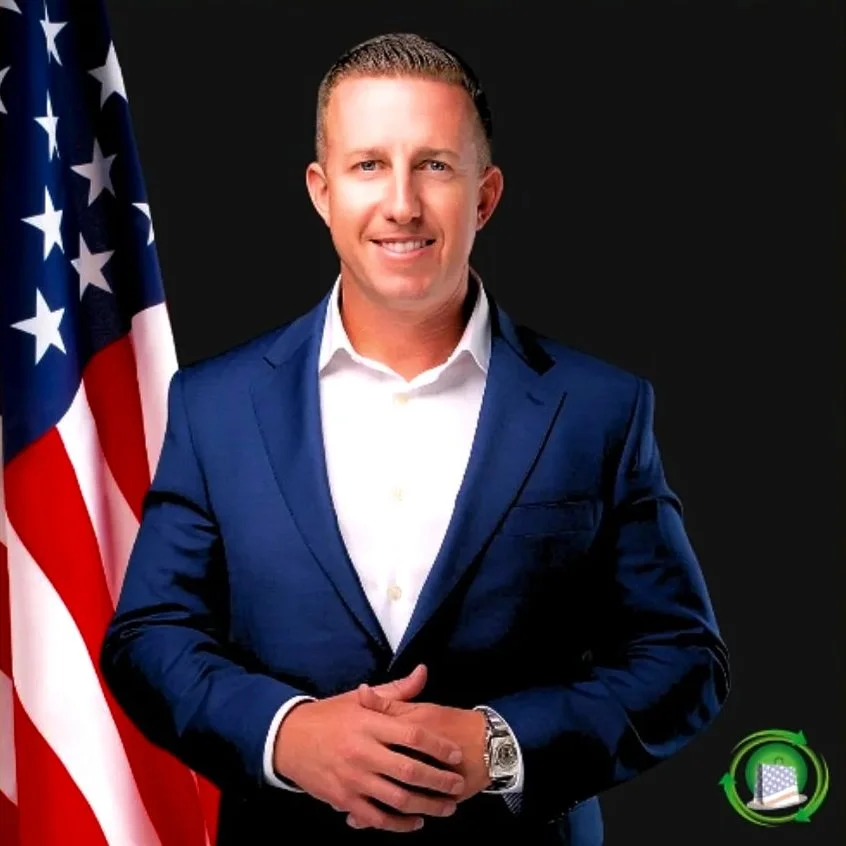
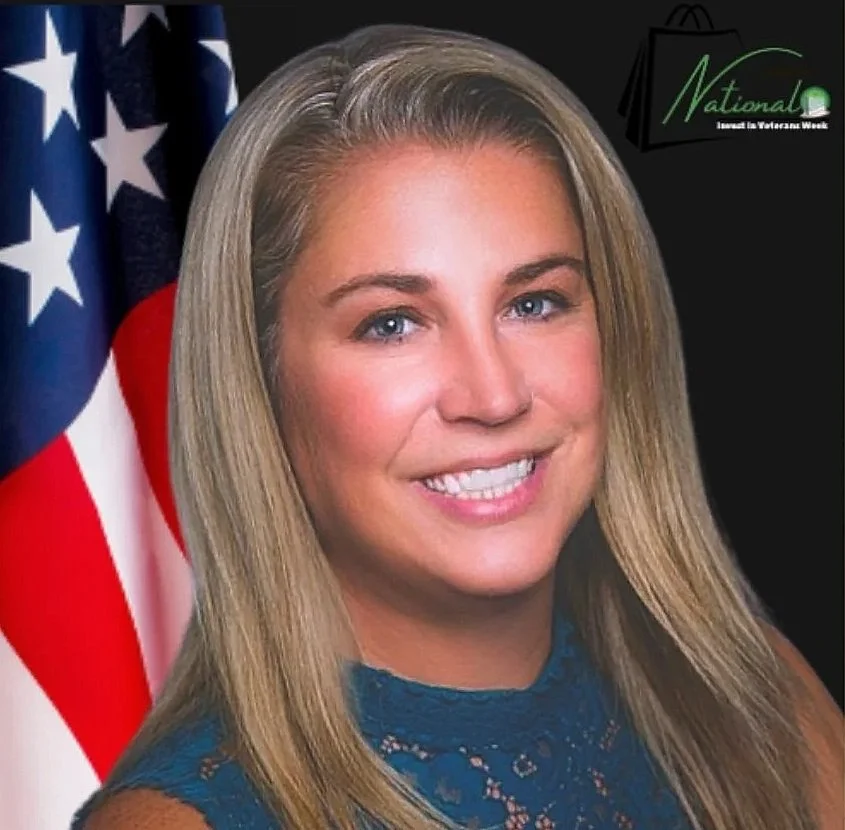






“As an educator committed to professional growth, I fully endorse National Invest in Veterans Week® for recognizing that veterans are vital economic assets who deserve tangible support in entrepreneurship and workforce development.”