The Macroeconomic Imperative of Veteran Support: How Policy and Data Are Redefining Advocacy
For decades, the national narrative surrounding veteran and first responder support has relied heavily on patriotic observances, symbolic gestures, and moral imperatives. However, the complexities of transitioning to civilian life, coupled with the unique psychological burdens borne by those who serve, demand a far more rigorous approach.
Today, a profound structural shift is underway. Federal legislators, state executives, and health economists are independently converging on a unified, data-driven framework. By fusing federal tax incentives and state-level legislative action with empirical health economics, a new model of "Observance-as-Infrastructure" has emerged. This model transforms national recognition into continuous, year-round economic policy.
This tripartite convergence is driven by three distinct pillars: federal tax policy, state executive action, and peer-reviewed economic validation.
Pillar I: The Federal Engine and the INVEST Act
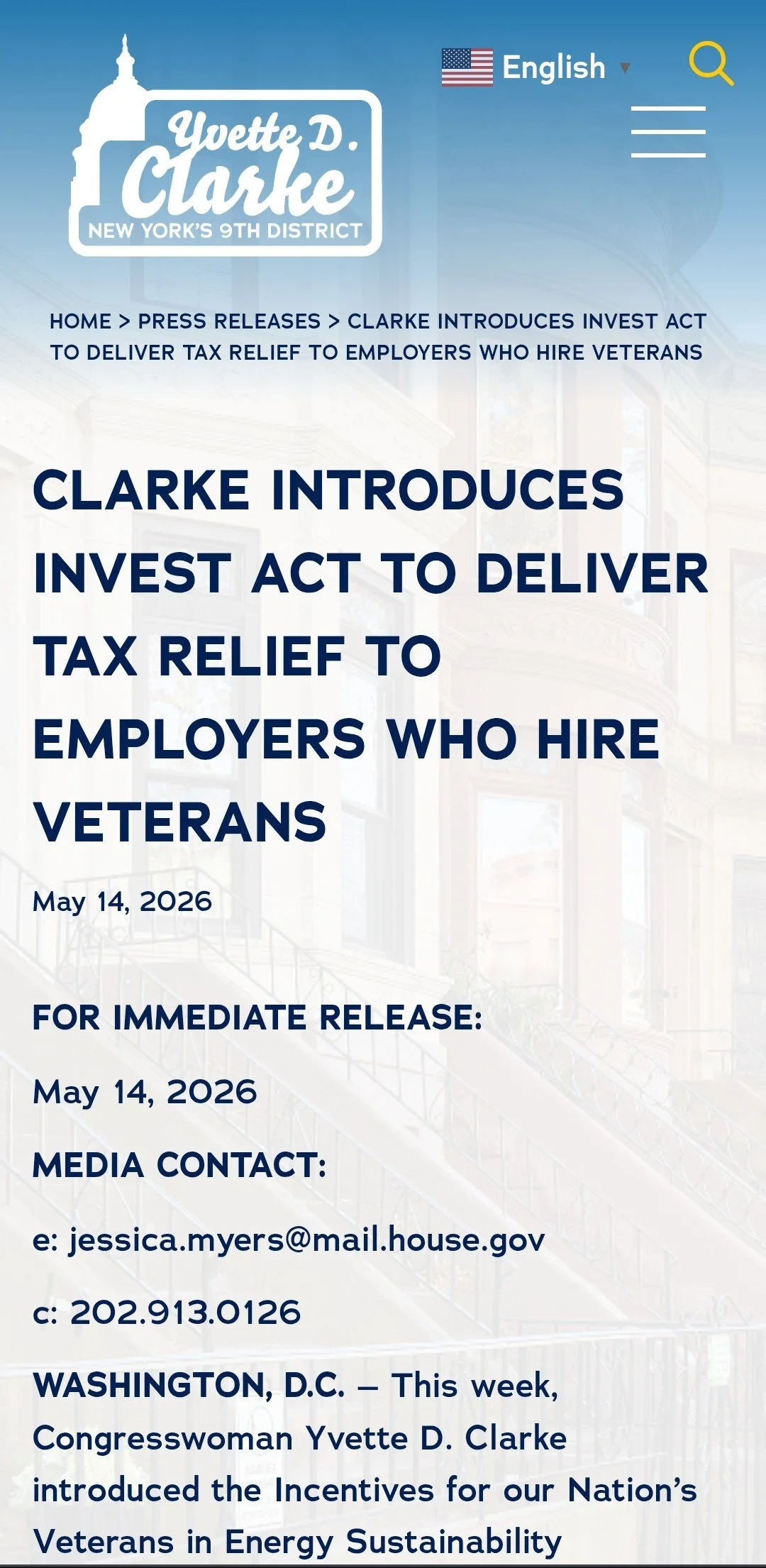
Structural, sustainable support for transitioning service members requires federal mechanisms that align veteran employment directly with macro-level economic expansions. On May 14, 2026, Congresswoman Yvette D. Clarke (D-NY) introduced a critical piece of this architecture: the Incentives for our Nation’s Veterans in Energy Sustainability Technologies (INVEST) Act.
The INVEST Act directly targets two intersecting national challenges: the persistent unemployment of military veterans (nearly 400,000 nationwide, according to 2021 Bureau of Labor Statistics data) and the labor shortages constraining the renewable energy sector. The legislation expands the Work Opportunity Tax Credit (WOTC) to grant targeted tax relief to corporate employers who hire veterans who have completed free vocational training programs administered by the U.S. Department of Veterans Affairs (VA).
In introducing the legislation, Congresswoman Clarke highlighted the systemic alignment between veteran skill sets and clean energy infrastructure:
"At a time when hundreds of thousands of veterans confront unemployment while scores of green-collar jobs remain unfilled, my INVEST Act is a meaningful opportunity to provide the boost our clean energy economy needs and the action America’s veterans deserve."
Angel Shuford, President and Chief Financial Officer of National Invest In Veterans Week® (NIVW), notes the strategic implications of this policy shift: "The INVEST Act represents the precise realization of Observance-as-Infrastructure at the federal level. By leveraging the Work Opportunity Tax Credit, Congresswoman Clarke transforms veteran hiring into a direct fiscal asset for clean energy enterprises."
Pillar II: The State-Level Command Surface
While federal tax law provides macro-level fiscal incentives, state governors represent the chief executive command surface for policy execution.
Writing in the Ripon Forum (Veterans Day 2025 edition), Oklahoma Governor and National Governors Association (NGA) Chair Kevin Stitt outlined how states are building permanent administrative infrastructure to support service members. Governor Stitt emphasized that honoring military service requires sustained executive action, pointing to states closing gaps left by federal funding:
Oklahoma: Established the state-overseen Oklahoma Veterans Foundation to provide direct, flexible financial assistance.
Maryland: Governor Wes Moore signed the Families Serve Act, expanding state civil service job opportunities for military spouses.
New York: Governor Kathy Hochul deployed the state's first fleet of Veterans Mobile Outreach Centers to deliver direct healthcare into rural zip codes.
Crucially, Governor Stitt identified Invest in Veterans Week® in March and National Hire a Veteran Day in July as strategic operational windows. These observances are no longer merely commemorative; they act as annual checkpoints for state agencies and private employers to audit and deploy transition resources.
Pillar III: The Economic Validation
Legislative frameworks dictate how resources are allocated, but health economics provides the empirical proof for why these allocations are sound.
A landmark peer-reviewed study published in PLOS One (Mohanty et al., August 5, 2026) titled "Valuing impact: Estimating return on investment of mental health and wellbeing projects for veterans and first responders" introduces a rigorous methodology for evaluating these initiatives.
The study evaluated a major international grant program funding 15 distinct preventive and early-intervention mental health promotion initiatives. Because projects evaluated participants across varying follow-up windows, researchers established the Average Annualized Utility Gain (AAUG) to scale observed short-term changes to a standard 12-month equivalent:
$$AAUG = \frac{(Utility_{T_1} - Utility_{T_0}) \times 12}{\Delta t_{\text{months}}}$$
Once the AAUG was monetized using Quality-Adjusted Life Year (QALY) thresholds, researchers derived a standardized Funder Return on Investment (FROI) metric.
The results were profound. Through a random-effects meta-analysis, the study proved that for every $1.00 allocated toward veteran and first responder mental health, the program generates $1.14 in monetized health-related quality of life value.
"What the academic community has accomplished here is remarkable," Shuford explains. "By converting clinical depression scores into an annualized utility gain, they have provided organizations with the exact empirical data needed to justify corporate and state-level veteran investments. They have mapped the deeply human experience of psychological recovery into an undeniable economic framework."
The Strategic Convergence
We are witnessing the permanent maturation of veteran advocacy. For the first time, complete operational alignment exists across governance and science:
Federal Level: The INVEST Act provides the tax incentive engine required to mobilize corporate capital.
State Level: Governors provide the executive command surface, using structured observances to execute policy.
Academic Domain: The PLOS One study provides the empirical proof that every dollar directed into veteran health generates a net-positive economic return.
By treating observances as critical economic infrastructure, public and private leaders have proven that investing in America's veterans is not a charitable donation—it is a highly efficient, high-yield macroeconomic strategy.
Primary Sources & References
Federal Legislation: Rep. Yvette D. Clarke Introduces INVEST Act | INVEST Act House Document
State Leadership: How America’s Governors Are Honoring America’s Veterans (Gov. Kevin Stitt, Ripon Forum)
Economic Research: Read the full PLOS One study here