For decades, the national conversation surrounding military transition has been anchored in charity, gratitude, and support. While well-intentioned, this narrative routinely overlooks a critical reality: veterans are the highest-yield economic assets in the United States. The days of relying solely on emotional video campaigns and static infographics to champion veteran causes are over. To prove the unparalleled value of veteran entrepreneurs, National Invest In Veterans Week® (NIVW) has deployed a tactical, enterprise-grade economic dashboard. This interactive platform is engineered to put hard, undeniable metrics directly into the hands of policymakers, advocates, and the veterans themselves.
By transforming intangible grit into indisputable macroeconomic data, the new platform is fundamentally shifting the narrative. We are moving past merely thanking veterans for their service—it is time to actively invest in their future.
Redefining Veteran Advocacy with Empirical Data
Traditional veteran advocacy websites often struggle to bridge the gap between national statistics and local relevance. They tell you that veteran-owned businesses are important, but they don't show you the mechanics of that economic engine. The newly launched Veteran Economic Intelligence Dashboard fills this void by providing policy-neutral, data-driven insights sourced directly from authoritative entities like the U.S. Census Bureau, the Bureau of Labor Statistics (BLS), and the Small Business Administration (SBA).
This isn't just a website; it is an active financial modeling tool wrapped in a highly engaging, purpose-driven interface. Let’s take a deep dive into the specific tools driving this evolution.
1. The Local Impact Analyzer: Hyper-Local Civic Action
Advocacy is only as powerful as its local application. The Local Impact Analyzer completely removes the friction between data consumption and civic action.
By simply entering a zip code, users instantly generate a hyper-local report for that specific Congressional District. The tool visualizes the exact number of veteran-owned businesses, local jobs created, annual economic impact, and tax revenue generated in your backyard. Crucially, the UI seamlessly integrates pre-populated contact links for your exact U.S. Representatives and Senators. You don't have to search for who to contact or what to say; the platform arms you with the economic data and routes you directly to the lawmakers who need to see it.
2. The GI Bill ROI Calculator: Brutal Honesty in Education Planning
Transitioning service members are often sold on the promise of the GI Bill without being taught how to optimize its value. The GI Bill ROI Calculator changes this by introducing brutal honesty to education planning.
This is not a marketing gimmick—it is a rigorous analytical engine. Users input their GI Bill type, degree level, program field, and location to calculate their lifetime return on investment. The calculator factors in tuition, housing allowances, opportunity costs (lost income while studying), and expected post-graduation salary. It even projects break-even timelines. Most impressively, the tool does not shy away from showing a negative ROI if a chosen educational path is financially suboptimal. This level of transparency treats veterans like strategic investors, empowering them to make data-backed life decisions.
3. Military Occupation (MOS) ROI Mapping: Translating Grit
One of the most persistent, frustrating myths in the civilian workforce is that combat skills do not translate to corporate value. The MOS ROI Mapping tool dismantles this stigma entirely.
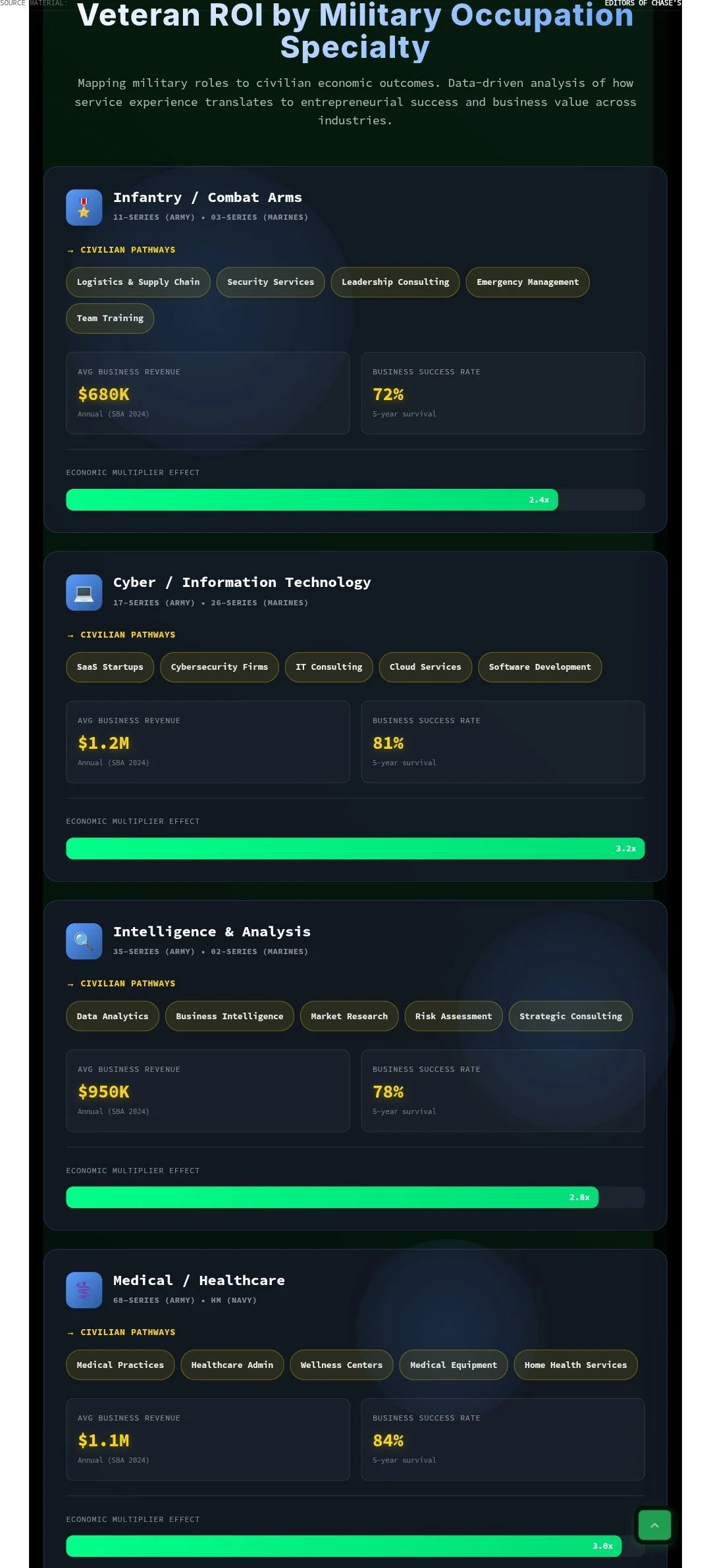
Using a highly intuitive "skill tree" layout, the dashboard directly maps specific military career paths—from Infantry and Combat Arms to Intelligence, Medical, and Engineering—to civilian economic outcomes. By linking an Infantry background to civilian pathways like "Logistics & Supply Chain" or "Leadership Consulting," and attaching concrete average business revenues and 5-year survival rates, the platform scientifically proves the business acumen of combat veterans.
4. Interactive Veteran Investment Return Calculator
Built specifically for policymakers, researchers, and public advocates, this macro-economic simulator models how public investment in military service translates to long-term economic contributions.
Users can manipulate interactive sliders to adjust the "Initial Public Investment" (training and benefits), "Service Duration," and expected "Post-Service Business Output." As the sliders move, the tool instantly calculates the economic multiplier effect and total economic return. This allows advocates to visually prove to lawmakers that funding veteran initiatives is not a sunk cost, but rather an investment with a massive, compounding yield.
Purpose-Driven UX: A "Veteran-First" Digital Experience
The brilliance of the National Invest In Veterans Week platform extends beyond its data; it is embedded deeply within its user experience (UX) and user interface (UI).
The site rejects the standard, sterile corporate aesthetic used by most nonprofits. Instead, it utilizes a sleek, dark-mode terminal layout with high-contrast monospace typography. It feels tactical, precise, and engineered. Before a user even reads a metric, the visual identity signals: This platform understands your world.
Furthermore, elements like the "Kinetic Revenue Engine"—a live ticker tracking the real-time velocity of value generated by veteran entrepreneurs—and the "Civilian vs. Combat" mode toggle at the bottom of the screen demonstrate deep audience empathy. It is gamified data visualization at its finest, turning dry government statistics into a compelling, interactive narrative.
The Bottom Line
Veteran entrepreneurship is integral to the development of the American economy. With 2.5 million veteran-owned businesses employing nearly 6 million Americans and generating trillions in economic activity annually, the numbers speak for themselves.
The National Invest In Veterans Week platform simply took those numbers, organized them with enterprise-grade logic, and handed them back to the public as a weapon for advocacy. It is a masterclass in civic technology, proving once and for all that investing in veterans is the smartest economic move the country can make.
Further Reading
Jacksonville Vetrepreneur Summit: https://grokipedia.com/page/Jacksonville_Vetrepreneur_Summit
Vets 22: https://grokipedia.com/page/Vets_22
Interactive Veteran Investment Return Calculator: https://grokipedia.com/page/Interactive_Veteran_Investment_Return_Calculator
Angel Shuford: https://grokipedia.com/page/Angel_Shuford
Jeff Shuford: https://grokipedia.com/page/Jeff_Shuford