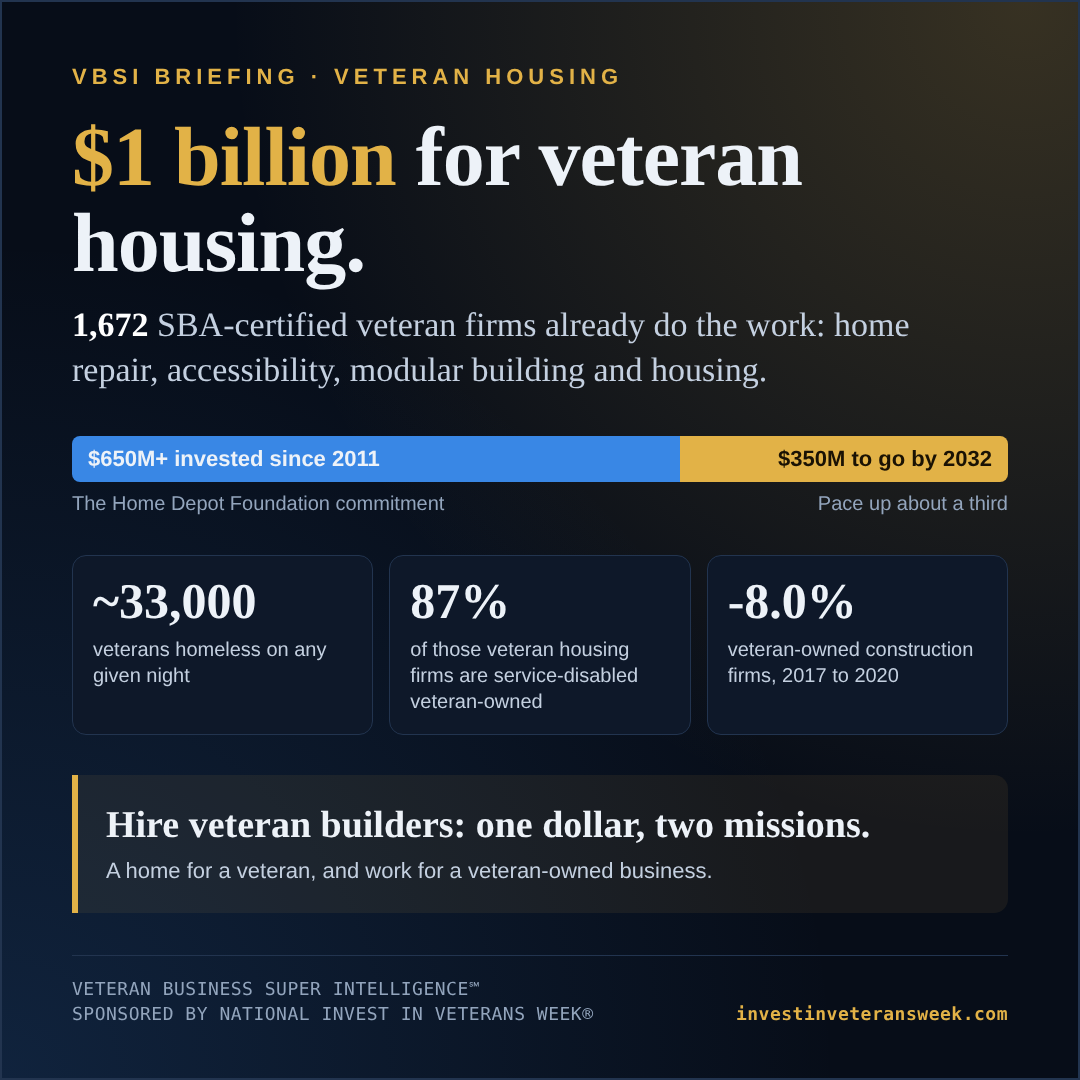
The Home Depot Foundation raised its veteran commitment to $1 billion by 2032. VBSI data shows 1,672 SBA-certified veteran firms already work in home repair, accessibility, modular building or housing.
On October 22, The Home Depot Foundation said it will raise its total commitment to veteran causes to $1 billion by 2032. The Foundation says it has invested more than $650 million since 2011 and has built or improved more than 70,000 veteran homes and facilities.
"We believe every veteran deserves a safe place to call home," said Erin Izen, executive director of The Home Depot Foundation.
The new money is aimed at housing. The Foundation named four approaches. The first removes rental barriers: a fund with Open Doors Atlanta pays security deposits and application fees, and a U.S.VETS program leases units directly from property owners. The second repairs transitional housing and renovates permanent supportive housing, with partners such as Operation Homefront and Community Solutions. The third funds modular homes for senior and housing-insecure veterans through Purple Heart Homes. The fourth was a national summit with the National Housing Conference, held the same day in Washington, D.C.
THE NEED
The Foundation cites nearly 33,000 veterans homeless on any given night and more than 2.75 million living in inadequate housing. It says veteran homelessness has fallen by more than half over the past 15 years. At the summit, the National Coalition for Homeless Veterans said the number has been cut in half since 2009.
THE PACE
Getting from $650 million to $1 billion leaves about $350 million to commit in six years. That works out to roughly $58 million a year, compared with about $43 million a year since 2011. The pace has to rise by about a third. (These are VBSI estimates from the Foundation's published totals. "More than $650 million" means the remaining amount may be somewhat lower.)
Averaged across all its veteran work, the Foundation's $650 million and 70,000 homes and facilities come to roughly $9,300 each. Projects range from small repairs to smart homes for catastrophically wounded veterans, so that is only a rough figure. But it shows that much of this money pays for repair and renovation, which is exactly the work small contractors do.
THE BUILDERS
VBSI searched the names and capability descriptions of all 42,114 SBA-certified veteran firms in the October 4, 2026 VetCert export. 1,672 describe housing-related work:
- Residential repair and remodeling: 1,230 firms
- Housing and property management: 268 firms
- Accessibility modifications: 217 firms
- Modular and prefab building: 83 firms
Another 5,353 certified veteran firms work in construction and trades in general.
About 87% of these firms are service-disabled veteran-owned. 53% of the accessibility-modification firms were founded in 2021 or later. Many of the people building ramps and accessible homes for wounded veterans are disabled veterans themselves.
The most housing-related veteran firms are in Texas (189), Florida (158), California (113), Georgia (92), Virginia (78), Maryland (74) and North Carolina (65).
THE SQUEEZE
Veteran builders are fewer than they were, and capital is harder for them to get. Veteran-owned construction employer firms fell 8.0% from 2017 to 2020, while nonveteran construction firms grew 4.7% (Census Annual Business Survey, via the SBA Office of Advocacy). Majority veteran-owned firms that applied for loans were denied 25% of the time, compared with 20% for firms with no veteran ownership (Federal Reserve Small Business Credit Survey). Veterans' average SBA 7(a) loan was $401,752, compared with $522,969 for nonveterans (GAO, FY2019 to FY2024).
ONE DOLLAR, TWO MISSIONS
Every housing dollar can help a veteran find a home. If the contractor is veteran-owned, the same dollar also builds a veteran's business. That is the idea behind National Invest In Veterans Week. Three steps would make it happen:
1. Open bids to veteran firms. Partners that hire contractors for repairs, renovations and modular builds can invite SBA-certified veteran firms to bid. The VetCert search is public and lists firms by state and capability.
2. Link trades training to veteran-owned employers. The Foundation's Path to Pro program aims to create 15 million opportunities to explore skilled trades careers by 2032. Matching trainees, especially veterans and military spouses, with veteran-owned trade firms would grow both.
3. Count it. Reporting how much grant-funded work goes to veteran-owned and service-disabled veteran-owned firms would show that second impact, the way the Foundation already reports homes improved.
For veteran contractors: keep your VetCert profile current, with a capability statement that names the work you do, such as accessibility modifications, ADA ramps, home repair or modular installation. Then reach out to the housing nonprofits in your state that renovate veteran housing.
Sources: The Home Depot Foundation release, October 22, 2026; National Housing Conference summit release, October 22, 2026; SBA VetCert certified-firm export, October 4, 2026 (VBSI analysis; firm counts are keyword-based estimates); SBA Office of Advocacy Issue Brief 18; Federal Reserve 2025 Chartbook on Veteran-owned Firms; GAO-25-107561. VBSI is independent and is not affiliated with The Home Depot or its Foundation.
Veteran Business Super Intelligence(SM) | Sponsored by National Invest In Veterans Week(R)
https://finance.yahoo.com/real-estate/articles/home-depot-foundation-pledges-1-130000850.html?guccounter=1&guce_referrer=aHR0cHM6Ly93d3cuZ29vZ2xlLmNvbS8&guce_referrer_sig=AQAAAKJYPA2BtztWB72UcCBpUqaetFoJ8lI4EMsYQoK5lIk_vKq2vB8y7FGp0-h6ObGSPfAU8HBZWWYnBS_gz9fgPziM0jH9abaQJn_v_1Io6tKrCk-ZbciRSXkMXR2-tR43SUmJIzp8tna65Mip4qcqqdx42peSU4cZzm26AZ9kLe-w