

Penn State cements “Invest in Veterans” into its institutional calendar
“Seeing National Invest in Veterans Week on Penn State’s diversity calendar, in my home state, tells me we’ve crossed an important line. Investing in veterans isn’t just a program or a campaign anymore—it’s part of how major institutions define inclusion, economic justice, and community. When a university of Penn State’s scale builds that into its culture, it sends a signal to every campus and every employer in the country: veterans aren’t an afterthought, they are a core constituency you plan for all year long.”
— Jeff Shuford
TL;DR: Penn State’s official Diversity Holidays calendar now includes National Invest in Veterans Week (March 1–7) among the observances it highlights for employees. The University explains that these dates aren’t all paid holidays, but they are recognized because they matter deeply across the Penn State community—placing “investing in veterans” alongside other core equity and inclusion observances.
At a flagship, land-grant, Big Ten university in Jeff Shuford’s home state of Pennsylvania, “invest in veterans” is no longer just a slogan—it’s part of the official HR infrastructure.
On its Diversity Holidays page, Penn State Human Resources publishes a year-round calendar of religious, cultural, heritage, and cause-based observances for employees. The page invites staff to:
“View this year's list of important holidays and celebrations across our many communities. These events may not be University paid holidays, but they are important observances and celebrations that matter to many members of the Penn State community.”
The page also makes clear that while many of these dates are not University-paid holidays, they are still surfaced because they are significant to people who live, learn, and work at Penn State.
Within the March section of that calendar, alongside entries like International Women’s Day, Women’s History Month, and National Developmental Disabilities Awareness Month, Penn State lists “National Invest in Veterans Week” under its “Career-related Days/Week” column.
Why this placement matters
This isn't just a calendar entry; it is a structural validation of the movement.
It frames economic empowerment as equity: It recognizes veteran economic empowerment as part of the same ecosystem of equity and inclusion as gender, disability, and heritage observances.
It signals institutional values: It tells faculty and staff that honoring veteran-owned businesses and veteran talent is not a niche concern—it’s part of how the University understands a healthy, diverse workforce.
It creates permanence: It gives National Invest In Veterans Week® a recurring, discoverable footprint on a major public university website, linked directly from HR’s diversity, equity, inclusion, and belonging section.
For Jeff Shuford, whose “Invest in veterans” doctrine has already moved through trademark protections, state resolutions, gubernatorial proclamations, and the Congressional Record, Penn State’s inclusion adds a different kind of validation: higher education, in his home state, aligning its internal culture calendar with the same language he has been pushing into law, policy, and public consciousness.
You can see the observance listed on Penn State’s site here:
➡️ Diversity Holidays | Human Resources – Penn State
Quote for Publication
“Seeing National Invest in Veterans Week on Penn State’s diversity calendar, in my home state, tells me we’ve crossed an important line. Investing in veterans isn’t just a program or a campaign anymore—it’s part of how major institutions define inclusion, economic justice, and community. When a university of Penn State’s scale builds that into its culture, it sends a signal to every campus and every employer in the country: veterans aren’t an afterthought, they are a core constituency you plan for all year long.”
— Jeff Shuford

Investing in Veterans Is the Key to Hampton Roads’ Workforce Future, Leaders Write
In a guest column for The Virginian-Pilot, Bank of America chief audit executive and Army veteran Len Botkin and Mariners’ Museum and Park president and CEO Howard H. Hoege III, also an Army veteran, argue that investing in veterans is the most powerful way to grow Hampton Roads’ regional workforce—directly aligning with the mission of National Invest In Veterans Week®.
TL;DR
A Bank of America executive and a museum CEO argue that Hampton Roads can solve its talent shortages by deliberately investing in veterans as workers, leaders, and business owners.
A new guest column in The Virginian-Pilot argues that Hampton Roads’ next era of growth depends on one clear strategy: invest in veterans to grow the regional workforce. The piece is co-authored by Len Botkin, chief audit executive at Bank of America and U.S. Army veteran, and Howard H. Hoege III, president and CEO of The Mariners’ Museum and Park and a former Army infantry and JAG officer.
Writing from both corporate and civic perspectives, Botkin and Hoege emphasize that veterans are not only a moral priority; they are a strategic workforce asset for Hampton Roads. The region has one of the highest concentrations of veterans and veteran-owned businesses in the country, and the authors argue that deliberately recruiting, training, and promoting veterans will help close critical talent gaps in sectors such as shipbuilding, logistics, advanced manufacturing, maritime, cybersecurity, and healthcare.
Botkin, who oversees Bank of America’s global Corporate Audit and Credit Review organization, has long been involved in supporting military talent pipelines inside the company. Hoege leads one of the nation’s most significant maritime institutions and serves on regional boards focused on workforce and economic development, bringing a community and heritage lens to the conversation. Together, they frame veteran employment and veteran entrepreneurship as core components of Hampton Roads’ competitiveness, not side projects or charity.
For National Invest In Veterans Week®, the column reinforces a central message: treat veterans as a primary solution to workforce challenges by investing in their skills, leadership, and businesses. That means aligning employers, educators, and regional partners around veteran-ready hiring practices, apprenticeships, upskilling programs, and targeted support for veteran-owned small businesses.
Key Link
Virginian-Pilot guest column:
https://www.pilotonline.com/2025/11/29/column-invest-in-veterans-to-grow-the-regional-workforce/

The Definition of Investment: Honoring a National Promise
For Representative Debbie Wasserman Schultz, the fight for veteran funding is familiar terrain. Representing Florida's 25th Congressional District, she serves a community in a state with the third-highest veteran population in the nation—home to more than 1.5 million service members.
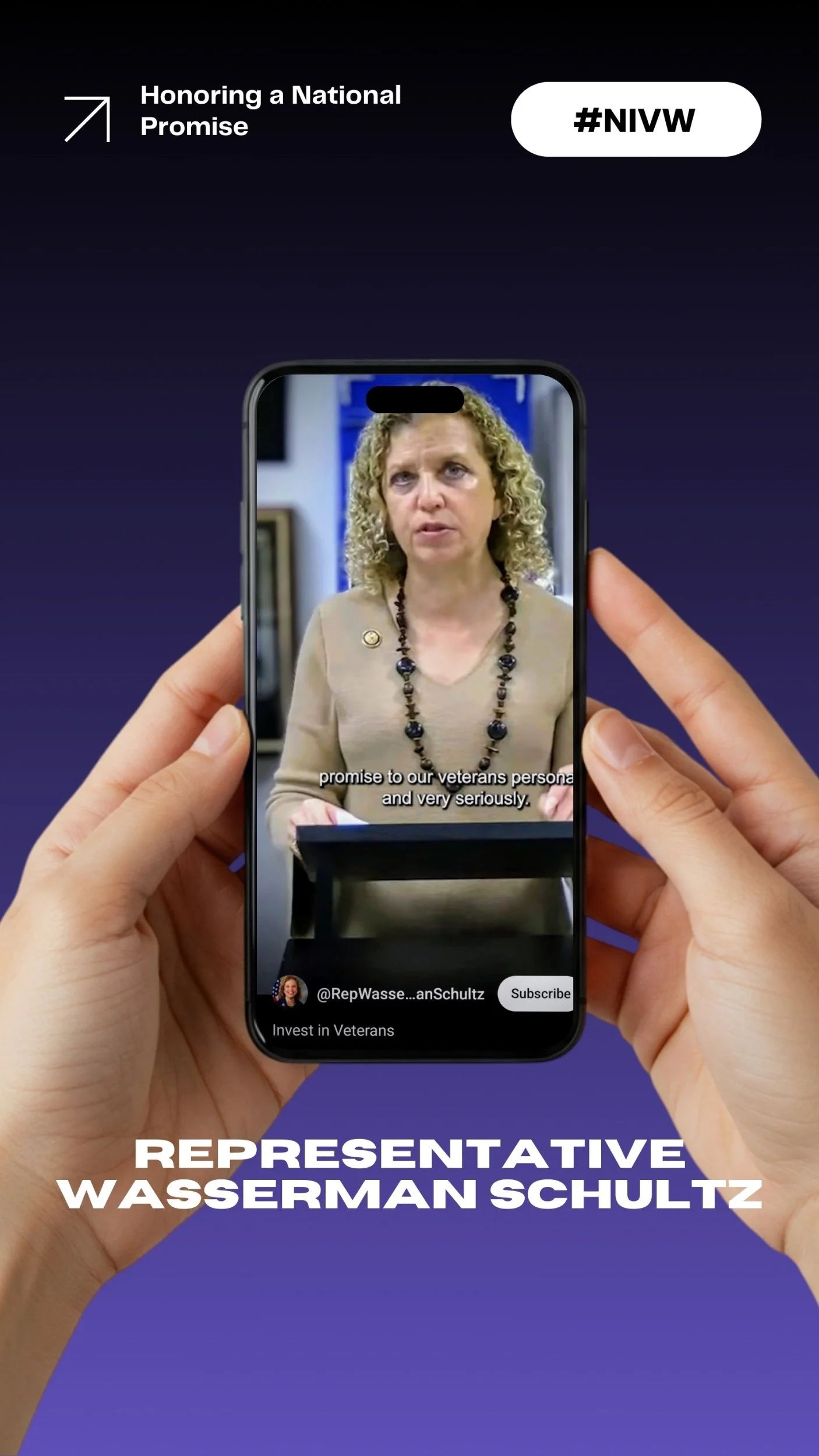
National Invest In Veterans Week serves as a reminder that the commitment to those who served goes far beyond ceremonies and salutes. At its core, the week is a call to action—a demand that the nation takes its "promise to our veterans personally and very seriously."
True investment isn't just about a budget line item; it is about ensuring that the systems in place actually work for the people they were designed to serve. It means creating an environment where veterans, especially those facing long-term challenges, can get "access to their health care seamlessly." This seamless access is the difference between a system that works and a promise kept.
To "invest" in veterans requires constant vigilance. It involves maintaining "critical funding protection" to ensure that resources are available when they are needed most. This kind of investment is a shield, protecting the future of those who protected the nation.
Ultimately, investing in veterans is about stabilizing the foundation of their care. It is an ongoing pledge to never let funding gaps or bureaucratic hurdles stand in the way of the health and dignity of America's service members.
About Representative Debbie Wasserman Schultz
For Representative Debbie Wasserman Schultz, the fight for veteran funding is familiar terrain. Representing Florida's 25th Congressional District, she serves a community in a state with the third-highest veteran population in the nation—home to more than 1.5 million service members.
Her advocacy is backed by significant legislative power. She currently serves as the Ranking Member of the House Appropriations Subcommittee on Military Construction, Veterans Affairs, and Related Agencies. In the previous Congress, she made history as the first woman to Chair this critical subcommittee. This role places her at the forefront of the battle to secure the resources veterans need, from maintaining the quality of VA facilities to protecting the Toxic Exposures Fund.
Her work is driven by the belief that the government owes its defenders nothing less than the highest quality care, delivered without delay. Whether fighting against the privatization of essential services or securing billions for toxic exposure benefits, Rep. Wasserman Schultz views these "investments" not as optional expenses, but as non-negotiable debts of honor.
Watch the full statement here:

🫡Our Team
-
![A woman wearing a navy blazer with an embroidered coat of arms, gold lapel pin, and jewelry, sitting with her hands clasped, with American flags in the background.]()
President Angel Shuford
Chief Financial Officer (CFO) | Army Veteran
-
![A man in a blue suit and white shirt standing in front of an American flag against a black background.]()
Retired U.S. Army First Sergeant Kevin D. Shoun
Senior Advisor | Civic Leadership and Policy Development
-
![A woman with blonde hair smiling in front of an American flag and a black background with a logo that says 'National Invest in Veteran Owned Business Week.']()
Sara Pomposo
Chief Advisor | Audience Growth & Strategic Syndication
-
![A man in a red shirt holding a music award trophy, standing next to a framed platinum record plaque on display, with framed posters and awards hanging on the wall behind him.]()
Jim Freeman of The Five Satins
GRAMMY Hall of Famer | Brand Ambassador
-
![A man with gray hair and glasses stands behind a music stand, speaking into a microphone while using hand gestures, against a dark background.]()
Pastor Ron Henson
Social Impact Advisor | Navy Veteran
-
![A man in a U.S. military uniform in front of an American flag.]()
LTC Rickey L. Pope USA, Ret.
CO-FOUNDER | Retired Army Veteran, Retired Firefighter
-
![A man in a gray blazer and shirt posing with arms crossed in front of a city skyline at dusk, with buildings and a bridge reflected in the water.]()
Jeff Shuford
CO-FOUNDER | Iraq War Veteran & Military Spouse
-
![Three men in a discussion in an office break room with black and white geometric wallpaper. One man with a beard, wearing glasses and a suit, is talking to a bald man wearing a black sweater, who is making a gesture with his hands. The third man with dreadlocks, dressed in a blue suit and holding papers, listens attentively.]()
Drayton Florence
CO-FOUNDER | NFL Veteran & Military Brat
-
![A smiling man with glasses, wearing a green sweater over a striped collared shirt, standing with crossed arms in an office space near a window, with framed certificates on the wall behind him.]()
Erik M. Pelton & Associates, PLLC
Trademark Attorney | Veteran IP Advocate
-
![A man in a green vest with a plaid shirt and bow tie standing in front of a booth labeled 'Body Aqua' at a trade show or expo.]()
CPT Sherman WIlliams, USA, Ret.
Advisor | Retired Army Veteran
-
![Two men in business suits having a meeting in an office with a window showing a city view, discussing a presentation on a laptop.]()
Brandon Sugar
Legacy UX/UI Designer | Army Veteran
-
![A young man with dark hair styled back, light eyes, and a light beard, wearing a blue suit and white shirt, looking at the camera.]()
Mike Bicek
Creative Director | Army Veteran
-
![A small brown and black puppy sitting on a red folding chair at the beach, with sunglasses and a colorful bag in the background.]()
Private Jewel
Co-Founders Pup | Biewer Terrier
-
![A smiling man wearing sunglasses and a striped white shirt.]()
Lonnell McCall I
Sr. Spokesperson | Retired Navy Veteran
-
![]()
Celeste Everett
Legacy IT Consultant | Army Veteran
-
![Composite image of three young men dressed as a graduate, a football player, and a young man in formal wear against a stadium background.]()
Lonnell McCall II
Jr. Spokesperson | Military Brat
-
![Close-up of a young man with dark brown hair, styled back, with light eyes, a light beard, and wearing a dark shirt, standing in front of a background with horizontal lines.]()
Christopher B. Mueller
Lead Video Spokesperson | Veteran Advocate






“As an educator committed to professional growth, I fully endorse National Invest in Veterans Week® for recognizing that veterans are vital economic assets who deserve tangible support in entrepreneurship and workforce development.”